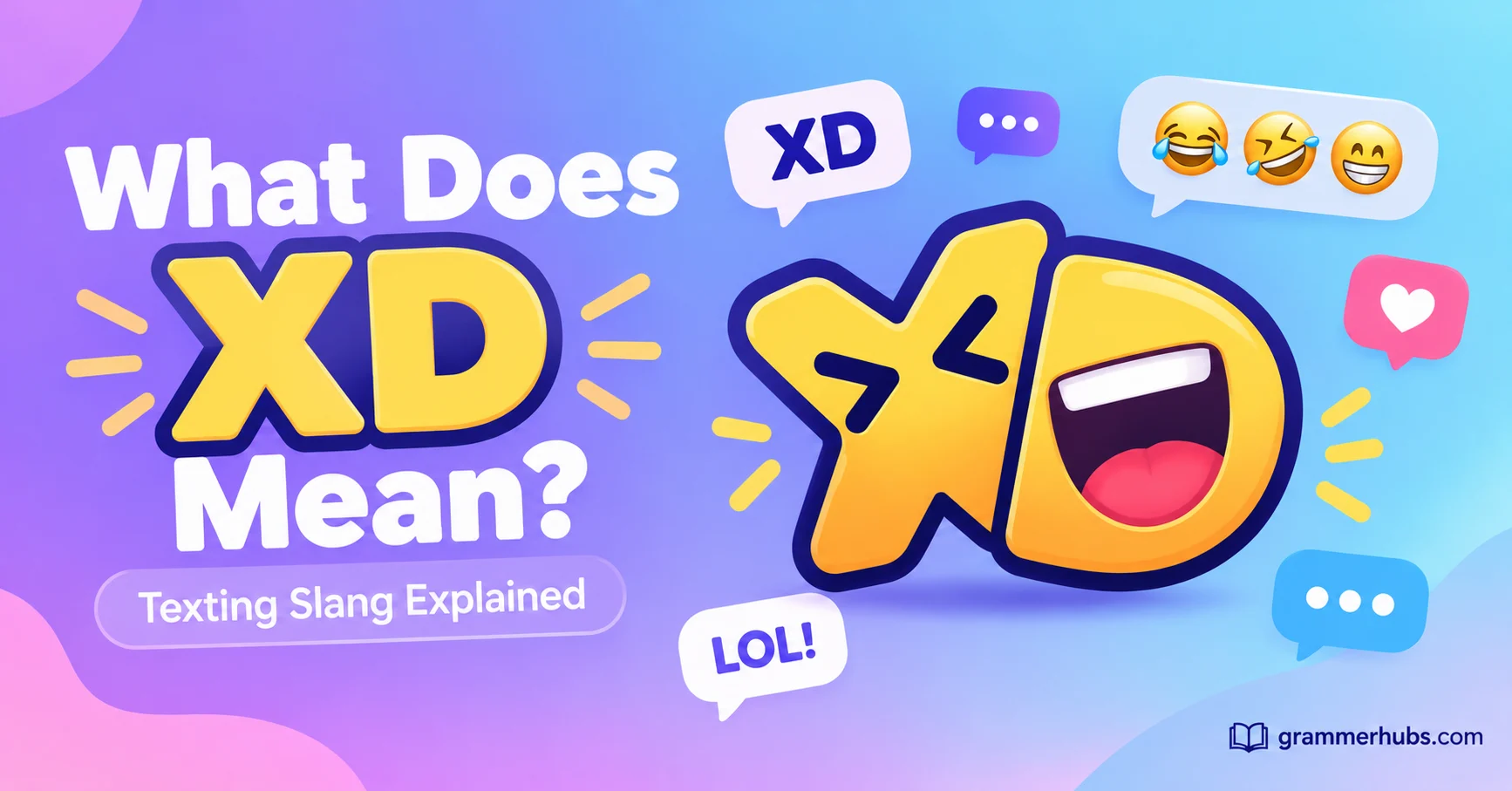
XD means someone is laughing hard enough that their eyes are squeezed shut. Tilt your head to the left and look at it again: the X becomes two scrunched-up eyes, and the D becomes a wide-open, laughing mouth. It’s not a word at all. It’s a face.
That one detail trips up a surprising number of people, which is exactly why this is worth breaking down properly where XD came from, how it’s actually used across texting, gaming, and social media, when it lands well and when it doesn’t, and why tone matters more than the symbol itself. By the end, you’ll never have to second-guess an XD again.
What XD Actually Means
XD is an emoticon with a face built from keyboard characters, the same family as the original 🙂 and :(. It represents intense laughter, more forceful than a simple smile.
Break it apart and it reads visually:
- X eyes shut tight, the way they get when something’s actually funny
- D an open, exaggerated grin or laugh
In practice, it rarely opens a conversation. It’s almost always a reaction a stand-in for the sound of laughing, dropped in right after something genuinely funny happened:
Friend: I just tripped over my own dog in front of my crush.
You: XD no you didn’t
Group chat: He thought the microwave was broken because he never pressed start XD
Gaming lobby: bro just walked off the cliff on purpose XD
XD is doing the job a real laugh would do if you were sitting in the room together. That’s the whole function of the symbol closing a gap that plain text can’t close on its own.
Where XD Came From
Emoticons as a category go back to 1982, when computer scientist Scott Fahlman suggested using 🙂 and 🙁 on an early university message board, as a simple way to flag when a post was a joke rather than something serious. That proposal is well documented in internet-history circles and is generally credited as the starting point for text-based emotion symbols.
XD specifically is a later addition to that family, and its exact birthdate is harder to pin down than 🙂 nobody filed a patent on it. What’s widely agreed on is that it grew out of late-1990s and early-2000s online culture: instant messaging, early forums, and especially multiplayer gaming communities, where players needed a fast way to react to something absurd happening mid-match without breaking their typing rhythm. A quick XD did more work than typing out that’s hilarious ever could.
From there it spread outward from gaming forums into general messaging apps, then into social media once platforms like Twitter and, later, TikTok made short, reaction-based comments the norm. It had real staying power. Most slang from that era has aged out completely; XD is still instantly recognizable two decades later, which says something about how well it captures a feeling that words alone struggle with.
How People Actually Use It
The core meaning of XD doesn’t change much depending on where you see it, but the rhythm of how it’s used shifts a bit by platform.
Texting between friends tends to use it as a quick emotional punctuation mark:
Sam: I called my teacher ‘mom’ in front of the whole class
Jess: XD you did NOT
Social media comments lean shorter and lower-effort a fast reaction while scrolling, not a full sentence:
the way he just gave up XD
Gaming chat is where XD probably feels most at home, because it matches the pace of live play:
Player1: revive me Player2: bro ran straight into the enemy team XD
Player1: I panicked!
Memes and captions sometimes use it more theatrically, leaning into absurd or chaotic humor rather than quiet amusement.
One pattern worth noticing across all of these: XD almost always shows up after the funny thing, not instead of a full reaction. People stack it, too XDDD for extra laughter, or paired with an emoji like XD 😂 when one symbol doesn’t feel like enough.
The Confusion Around It Cleared Up
A few misconceptions come up often enough that they deserve direct answers.
Is XD a typo? No. It looks like a random string of letters if you’ve never seen it explained, but it’s intentional and widely recognized.
Is it sarcastic or mean? Almost never on its own. XD reads as genuine amusement. If a message feels mocking, that’s coming from the wording around it, not the symbol itself.
Is XD outdated? It depends who you ask. Some younger users treat it as slightly nostalgic. Plenty of others still use it completely sincerely. Neither camp is wrong; it’s more a generational texture thing than a right-or-wrong usage question.
Is it the same as :D? Close, but not identical. 😀 is a smile. XD is a laugh. One is calmer, the other is louder.
XD Compared to Similar Expressions
XD isn’t the only way to signal laughter in text, and knowing where it fits next to its closest relatives makes it easier to pick the right one for the moment.
| Expression | What it signals | Typical formality |
| XD | Intense laughter, eyes shut visual and expressive | Very casual🤣 |
| 😀 | Plain happiness or a big smile | Casual |
| LOL | Mild-to-moderate amusement, very neutral | Casual to semi-neutral🙂 |
| LMAO | Strong laughter, a bit edgier in tone | Casual 😀 |
| 😂 | Universally understood laughter emoji | Casual to semi-neutral |
| Haha / hehe | Soft, low-key laughter | Friendly, casual |
LOL has become so common it barely registers as an actual reaction anymore it’s closer to a verbal tic.
XD, because it’s a little face rather than an acronym, still carries a more visible personality. It reads as more animated, sometimes more playful or younger-skewing, which is exactly why it doesn’t always fit formal settings the way haha comfortably does.
How to Respond to an XD
The right response depends entirely on who sent it and where.
With a close friend, matching the energy works fine:
XDDD stop I’m actually crying
With someone you don’t know well, or in a semi-formal group, mirroring the humor without the symbol usually feels safer:
Haha, that’s a good one!
In a professional context say it somehow shows up in a work chat best to respond in kind but dial it down:
Ha, that’s great, thanks for sharing!
If you’d rather not commit to a symbol at all, a simple emoji or a plain haha does the job without over-committing to a tone you’re not sure fits yet.
Is It Ever Offensive?
No not inherently. XD doesn’t carry a hidden or inappropriate meaning. Any negative read comes entirely from what surrounds it. XD after a genuinely funny story is harmless. XD tacked onto a dismissive or cutting comment can feel mocking but that’s the sentence doing the damage, not the four characters at the end of it.
That’s true of basically all internet shorthand: the symbol amplifies whatever tone is already there. It doesn’t create a tone on its own.
Should You Use It at Work?
Generally, no. XD reads as very casual closer to gaming-chat energy than office-appropriate so it’s best kept for friends, group chats, and informal social platforms. For work messages, close alternatives keep the warmth without the overly casual edge:
- Haha, that’s great!
- That’s hilarious.
- Ha, good one.
A decent rule of thumb: if you’d hesitate to send a winking emoji in that same message, skip XD too.
On Dating Apps and Online Communities
XD shows up a lot on Discord and Twitch, where fast, reactive chat is the norm and there’s no time to type out full sentences. On Twitter/X, it tends to appear under absurd screenshots or unexpected news, usually with minimal extra text attached.
Tinder or Bumble, it can land fine early in a conversation as a light, low-pressure reaction to a joke. It’s worth reading the room, though if your match’s texting style is more measured, an XD can come across as a bit more juvenile than intended. The safer move is matching their energy rather than leading with your own default style.
Quick Answers (FAQ)
What does XD mean in a text message?
It means the sender is laughing hard; the emoticon reads as squeezed-shut eyes (X) and an open laughing mouth (D) when viewed sideways.
Is XD the same as :D?
Not quite. 😀 is a plain smile; XD is a more intense laugh.
Can XD be used at work?
It’s better avoided in professional messages; something like haha or that’s great reads more appropriately.
Does XD have a hidden or offensive meaning? No. Any negative tone comes from the message around it, not the symbol itself.
The Bottom Line
XD isn’t a mystery once you see it for what it is: a sideways face, not a code to crack. It means genuine, hard laughter, it’s been part of internet shorthand for over two decades, and it still shows up everywhere from group chats to gaming lobbies because nothing else quite replicates that I can’t even keep my eyes open in reaction to four keystrokes.
The only real judgment call is where to use it. Among friends, in gaming chat, or on casual social media, it’s completely natural. In a work email or a message to someone you don’t know well, it’s better swapped for something more measured, like haha or that’s great.
Get that context right, and XD does exactly what it was built to do, carry a laugh across a screen that words alone can’t quite deliver.
Discover Other Posts!
Under the Weather Meaning: What Does It Really Mean? Examples & Origin
Crying Emoji Really Means. It’s Not Sadness Anymore. Here’s Why
Moon Emoji 🌙 Decoded: Flirty, Casual, or Just Tired

I’m Emma Reynolds, and I live and breathe everyday slang at GrammerHubs.com. I love breaking down the weird, short ways we text each other. No boring grammar lessons here, just real talk about how we actually chat.