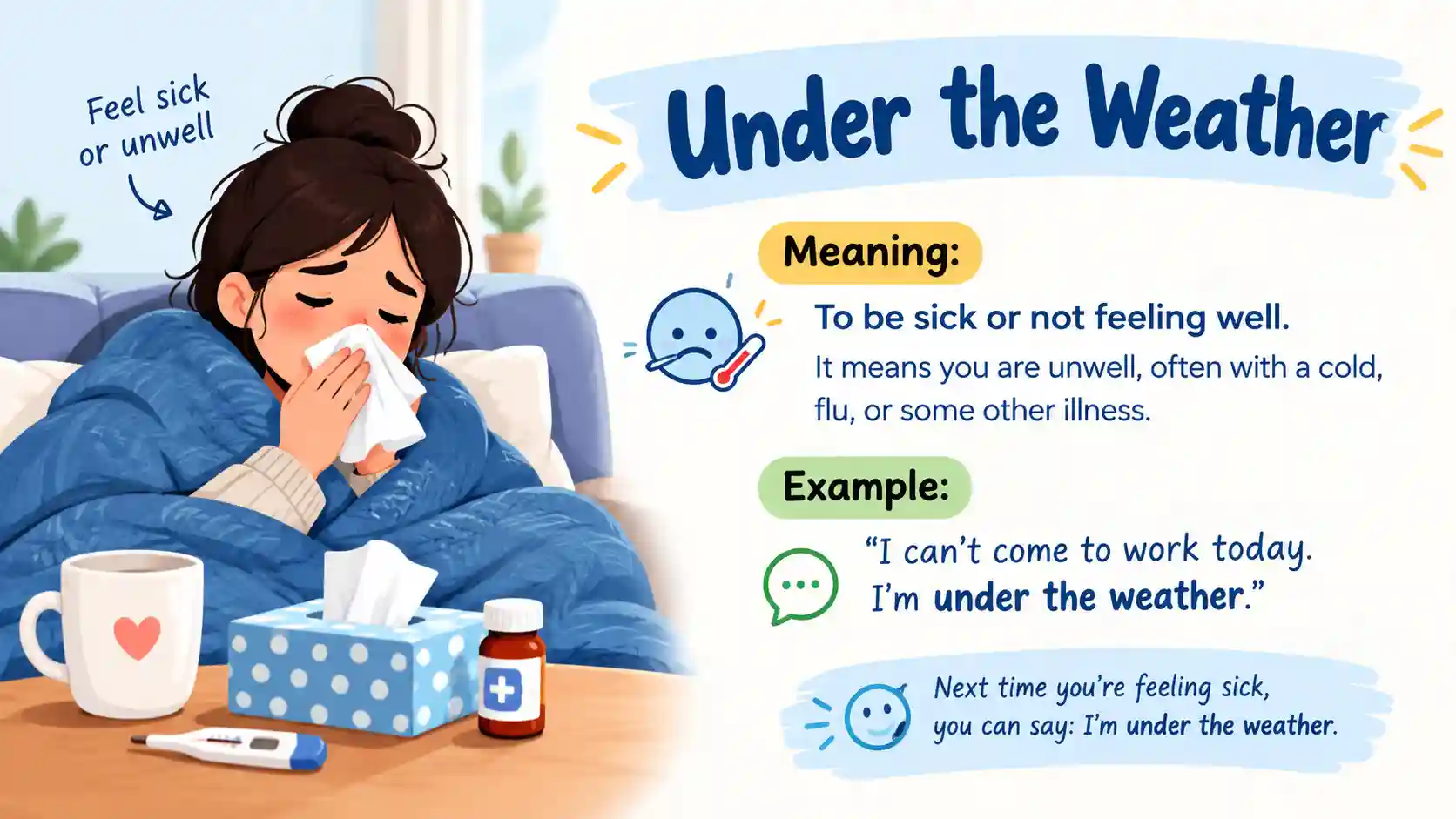
Have you ever heard someone say “I’m under the weather” and wondered what they really meant? The simple under the weather meaning is feeling sick, unwell, weak, or not quite yourself. It usually describes a mild illness, such as a cold, headache, tiredness, or an upset stomach.
For example, if your friend says, “I’m feeling under the weather today,” they simply mean “I’m not feeling well today.”
But why does an expression about weather mean being sick? And is it formal, informal, or something you can use in everyday American English? In this guide, you’ll learn the meaning, real-life examples, correct usage, origin, synonyms, and common mistakes so you can use under the weather confidently.
What Does “Under the Weather” Mean?
Under the weather means feeling sick, unwell, weak, or slightly ill.
It is an idiom, which means the phrase has a meaning that is different from the literal meaning of its individual words.
For example:
“I’m under the weather today, so I’m going to rest.”
This means:
“I’m not feeling well today, so I’m going to rest.”
The phrase often suggests a mild or temporary health problem, such as a cold, headache, upset stomach, tiredness, or low energy.
You may also hear:
“I’ve been under the weather all week.”
This means the person has not felt well for several days.
Under the Weather Meaning in Simple English
In simple English, under the weather = not feeling well.
It is similar to saying:
- I feel sick.
- I feel unwell.
- I’m not feeling well.
- I don’t feel like myself.
The exact reason for feeling unwell does not have to be explained.
How to Use “Under the Weather” in a Sentence
Under the weather is usually used with be or feel.
Common sentence patterns include:
- “I’m under the weather.”
- “I’m feeling under the weather.”
- “She’s been under the weather.”
- “He was a little under the weather yesterday.”
- “We’re both feeling under the weather.”
You can also add words such as a little, a bit, or slightly:
“I’m feeling a little under the weather today.”
This sounds natural because the idiom often refers to feeling somewhat unwell rather than describing a specific serious illness.
You can also use it with time expressions:
“I’ve been under the weather since Monday.”
“She was under the weather for a few days.”
“I’m still feeling under the weather.”
Is “I’m Under the Weather” Correct?
Yes. “I’m under the weather” is grammatically correct and very common.
You can also say:
“I’m feeling under the weather.”
However, you should not say:
“I under the weather.”
The phrase needs a verb such as am, is, are, was, were, feel, or feeling.
Under the Weather Examples
Here are some natural examples of under the weather in everyday English.
“I’m feeling under the weather, so I’m going to bed early.”
The speaker does not feel well and wants to rest.
“Tom was under the weather and skipped the party.”
Tom was feeling sick, so he did not go to the party.
“I’ve been a little under the weather lately.”
The speaker has not felt completely well recently.
“Are you okay? You look a little under the weather.”
The speaker thinks another person looks tired or unwell.
“She called in sick because she was under the weather.”
She stayed home from work because she did not feel well.
“I was under the weather yesterday, but I feel much better today.”
The speaker felt sick yesterday but has improved.
These examples show that the phrase can be used naturally in conversations, texts, and casual workplace communication.
Is “Under the Weather” Formal or Informal?
Under the weather is mainly an informal expression.
It is common in everyday conversations with:
- Friends
- Family
- Coworkers
- Classmates
- People you know casually
For example:
“I’m a bit under the weather today.”
This sounds natural in a casual conversation or message.
For a doctor, medical report, or other formal situation, it is usually better to describe the actual symptoms.
Instead of:
“I’m under the weather.”
you could say:
“I’ve had a sore throat and a fever since yesterday.”
The idiom tells someone that you do not feel well, but it does not explain exactly what is wrong.
Is “Under the Weather” an American Expression?
Yes. Under the weather is commonly used in American English, and most American English speakers understand it to mean feeling sick or unwell.
For example:
“I’m feeling under the weather today.”
“Dad is a little under the weather.”
“I was under the weather yesterday, but I’m better now.”
The phrase is also used and understood in British English and other varieties of English. Its basic modern meaning stays the same.
Where Did “Under the Weather” Come From?
The exact origin of under the weather is uncertain, but the phrase has a documented connection with nautical language.
Historical evidence shows that the expression was used in connection with ships and bad weather before its modern everyday meaning became established. Etymonline traces an early figurative meaning of “indisposed” to around 1810 and also records an earlier nautical use involving a ship seeking shelter from bad weather.
A documented use from 1786 referred to a ship reaching safe anchorage “under the weather.”
A popular explanation connects the phrase with sailors who became sick or seasick during rough weather. They may have gone below deck to get away from strong wind, rain, and waves. In this explanation, being under the weather created the idea of being sheltered from harsh weather.
However, this should be treated as a possible explanation rather than a proven single origin. The history of the phrase is more complex than the simple sailor story often repeated online.
Older uses of the expression also included meanings related to being in difficulty or being intoxicated.
“Under the Weather” vs. “Feeling Sick”
Under the weather and feeling sick can mean similar things, but they have a different tone.
Feeling sick is more direct:
“I’m sick.”
Under the weather is softer and less specific:
“I’m feeling under the weather.”
The second sentence simply tells us that the person does not feel well. It does not tell us whether they have a cold, headache, stomach problem, or another issue.
For a mild illness, under the weather can sound more casual and conversational.
For a serious health problem, however, the phrase may sound too mild. In that situation, a more specific description is usually better.
“Under the Weather” vs. “Feeling Down”
These two phrases can be confused, but they usually describe different things.
Under the weather normally refers to physical illness or feeling physically unwell.
Feeling down usually refers to sadness, disappointment, or low mood.
For example:
“I’m under the weather because I have a bad cold.”
This describes a physical problem.
“I’m feeling down because I lost my job.”
This describes an emotional state.
So, if someone says they are under the weather, the most likely meaning is that they are physically unwell.
Can “Under the Weather” Mean Drunk?
Yes, but this is a much less common meaning in modern everyday English.
Merriam-Webster lists drunk as another meaning of the phrase, and historical uses also connect under the weather with intoxication.
Context is important.
If someone says:
“I’m feeling under the weather today.”
most people will understand this as:
“I’m feeling sick.”
If the conversation is specifically about drinking or a night out, the phrase could have a different meaning.
Because the illness-related meaning is much more common today, you should not assume that under the weather means “drunk” unless the context clearly supports it.
Synonyms for “Under the Weather”
Depending on the situation, you can use several similar expressions:
| Expression | Meaning |
| Feeling sick | Feeling ill |
| Feeling unwell | Feeling unhealthy or sick |
| Not feeling well | A general way to say you feel sick |
| A little off | Not feeling quite normal |
| Out of sorts | Feeling unusual or not like yourself |
| Run-down | Feeling tired, weak, or low on energy |
For example:
“I’m feeling unwell today.”
“I’m not feeling well.”
“I’m a little run-down.”
“I’m feeling a bit off.”
These expressions can often replace under the weather, depending on the context.
Common Mistakes With “Under the Weather”
One common mistake is understanding the phrase literally.
When someone says:
“I’m under the weather.”
they usually do not mean they are physically underneath a cloud or storm.
Another mistake is treating the expression as a medical diagnosis. Under the weather is a general idiom. It does not identify a specific illness.
It is also normally used to describe a person:
Natural:
“I’m feeling under the weather.”
“She has been under the weather.”
Not natural:
“The weather is under the weather.”
Remember that the phrase is mainly used to describe someone’s health or general condition.
FAQs About “Under the Weather”
What does “under the weather” mean?
Under the weather means feeling sick, unwell, weak, or not quite healthy. It is an informal English idiom often used for a minor or temporary illness.
Is “under the weather” an idiom?
Yes. It is an idiom because its meaning is not meant to be understood literally. It describes someone who is feeling unwell rather than someone who is physically beneath the weather.
Can I say “I am under the weather”?
Yes. “I am under the weather” is grammatically correct and natural. “I’m feeling under the weather” is also very common.
Is “under the weather” formal?
No. It is mainly an informal expression used in everyday conversations, messages, and casual workplace communication. For medical or very formal writing, a more specific description is usually better.
Does “under the weather” mean sick?
Yes. This is the main modern meaning of the phrase. It generally means that someone is feeling ill or not well.
Where did “under the weather” come from?
The phrase has nautical roots, but its exact development is uncertain. Historical evidence shows nautical uses before the modern figurative meaning. A common theory connects it with sailors and ships dealing with rough weather.
Conclusion
The under the weather meaning is simple: feeling sick, unwell, weak, or not quite yourself. It is a common informal English idiom, especially useful when you want to say that you do not feel well without explaining exactly what is wrong.
So, when someone says “I’m under the weather today,” they usually mean “I’m not feeling well today.” The phrase can describe a cold, tiredness, a headache, or another mild health problem.
Its history appears to have connections with nautical language, although the exact origin is not completely certain.
Now that you know what under the weather means, remember one simple idea: it is not about the weather—it is about how someone feels.

I’m Emma Reynolds, and I live and breathe everyday slang at GrammerHubs.com. I love breaking down the weird, short ways we text each other. No boring grammar lessons here, just real talk about how we actually chat.










2 thoughts on “Under the Weather Meaning: What Does It Really Mean? Examples & Origin”