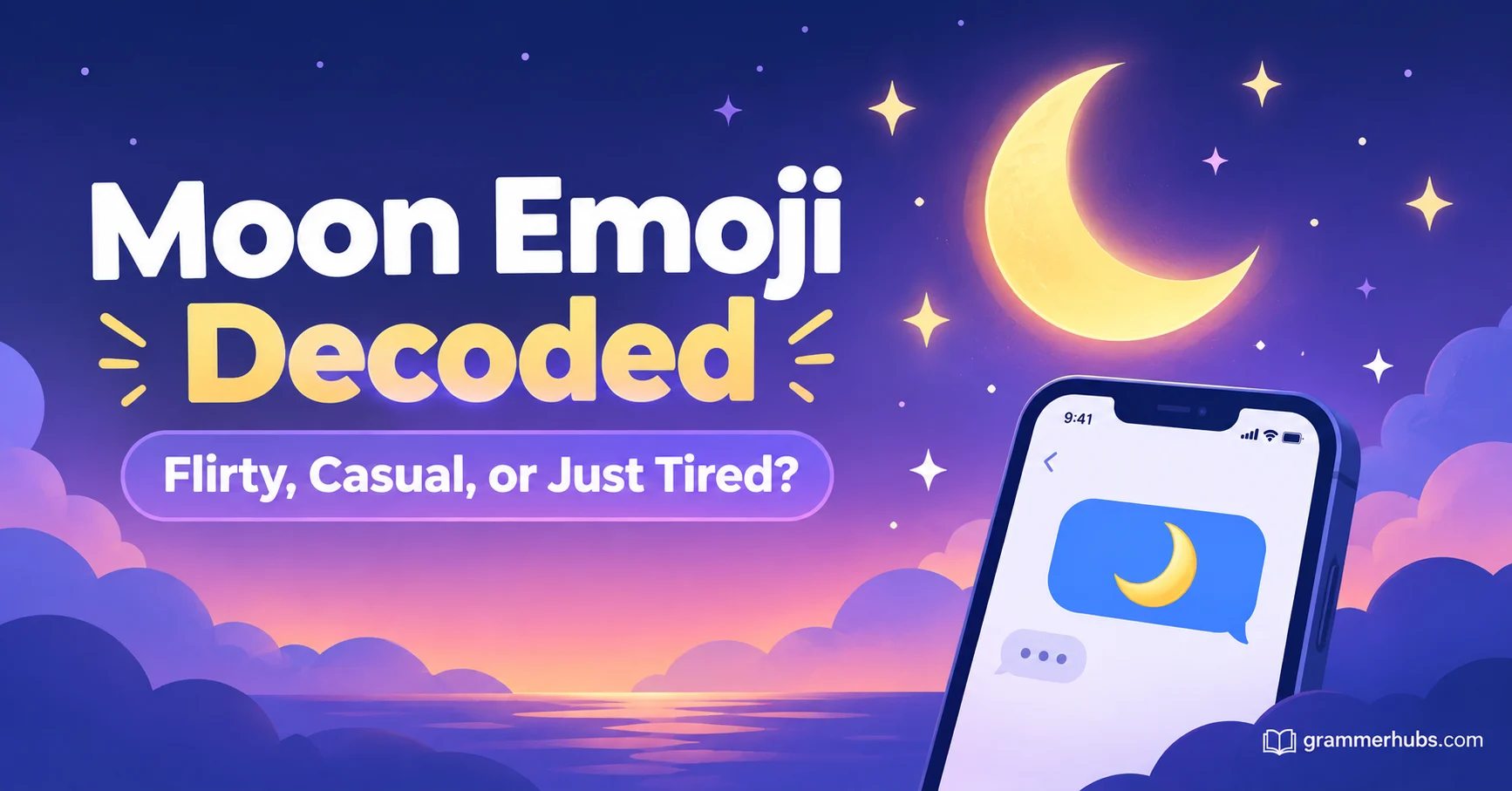
Someone sends you a single 🌙 no words, no context, nothing to go on but a tiny glowing crescent and suddenly you’re re-reading the last ten messages trying to figure out what changed.
The moon emoji usually means the sender is thinking of you late at night, winding down, or dropping a low-pressure, slightly affectionate signal without having to spell it out in words. Sometimes it’s flirty. Sometimes it just means it’s late and I’m tired. The difference almost always comes down to timing, tone, and who’s sending it.
Emoji like this one have become a real part of how people communicate feelings in texting, dating apps, and social captions, often carrying more emotional nuance than the words around them.
What Does the Moon Emoji Actually Mean?
The moon emoji’s literal meaning is simple: it’s a picture of the moon. But in texting, it rarely stays that literal.
According to Emojipedia, the crescent moon 🌙 is officially described as representing the moon generally and is commonly used for saying goodnight. It was approved as part of Unicode 6.0 in 2010 and added to the emoji keyboard in 2015 so this isn’t some new slang invention, it’s a symbol that’s had over a decade to pick up cultural baggage.
In casual conversation, here’s what it tends to signal:
- A goodnight, but softer
Faster and cozier than typing out the whole word. - You’re on my mind right now.
Especially when sent unprompted, late in the evening. - A calm or reflective mood.
Often paired with captions about quiet nights or slowing down. - A gentle flirt.
Particularly when paired with other emoji like ✨ or 💫, or sent in a conversation that already has romantic undertones.
A quick example of how it plays out:
Sam: can’t sleep, keep thinking about our conversation earlier 🌙
Riley: same, honestly. moon’s out and I’m just sitting with it
Neither message says I like you outright, but the moon is doing quiet emotional work in the background and it softens the admission without making it feel heavy.
The specific version someone sends changes the tone slightly:
- 🌙 Crescent Moon the default, general-purpose nighttime or goodnight emoji
- 🌕 Full Moon often used for big feelings, fullness, or things coming together
- 🌑 New Moon quiet, reflective, sometimes tied to fresh starts
- 🌚 New Moon Face playful, a little sly often used the way people use 👀 to imply they’re watching something unfold
- 🌝 Full Moon Face cheeky or teasing, sometimes self-deprecating humor
None of this is fixed or official; its meaning was built up organically through years of shared use, which is worth keeping in mind before assuming any single interpretation is the correct one.
Where the Moon Emoji Shows Up (and What Changes the Meaning)
Context does most of the heavy lifting here. The same 🌙 can mean five different things depending on where it lands.
In everyday texting, it usually just reinforces mood or timing:
Jess: Are you still up?
Mark: yeah, can’t sleep 🌙
Low stakes, mostly literal just confirming it’s late.
In social media captions, it leans aesthetic paired with a night-sky photo, a candle, or a slowing down kind of post. Less about signaling to one specific person, more about setting a mood for an audience.
On dating apps, this is where it carries the most weight. A moon sent late at night, without other context, often reads as a soft, low-pressure way of saying I’m still thinking about this conversation.
Match: 🌙
You: hi moon person, what’s keeping you up?
In gaming chats or Discord, it’s often just decorative, a status marker, a username flourish, or genuinely nothing more than habit. Not every moon is loaded with meaning; sometimes people just default to whatever’s in their recently-used row.
In professional messages, it’s uncommon and usually best avoided.
The pattern across all of these: the moon emoji rarely carries meaning entirely on its own. It borrows tone from the conversation, the timestamp, and the relationship between the two people involved.
Common Misreadings Worth Clearing Up
It doesn’t automatically mean flirting.
Plenty of people use 🌙 as a literal, no-agenda goodnight especially with friends or in group chats. Assuming romantic intent from the emoji alone, without reading the rest of the conversation, is how a lot of mixed signals happen.
The moon-face and moon-phase versions aren’t interchangeable.
🌚 in particular has taken on a sneakier, more teasing tone online closer to a silent I see what’s happening here than a straightforward goodnight. Swapping it in for 🌙 without meaning to can change how a message lands.
Not every moon emoji is intentional.
Sometimes it’s just muscle memory. Reading deep subtext into every single send can lead to overanalyzing what was actually a pretty casual message.
Can it come across as inappropriate?
Occasionally mostly when it’s sent very late at night, repeatedly, to someone who hasn’t shown much interest back. In that specific situation it can feel more pushy than sweet. Context and reciprocity matter more than the symbol itself.
Similar Emoji and Phrases People Use Instead
| Emoji / Phrase | Typical Tone | Best Used For |
| 🌙 Moon | Dreamy, soft, late-night | General nighttime mood or a gentle sign-off |
| ✨ Sparkles | Excited, magical | Adding emphasis to something charming |
| 😴 Sleepy face | Literal tiredness | Straightforward I’m exhausted |
| 🌌 Milky Way | Reflective, poetic | Introspective or artistic captions |
| ⭐ Star | Admiration, hope | Compliments or encouragement |
| Goodnight (spelled out) | Warm, direct | When you want zero ambiguity |
How to Respond to a Moon Emoji
If you’re not sure how to reply, match the energy rather than overanalyzing it.
Casual:
haha moon vibes tonight? what’s got you up
Flirty, if that’s the direction things are already going:
Are you thinking about me under that moon? 🌙
Neutral, if it shows up somewhere unexpected (like a work chat):
Good evening! Wrapping up here too.
If you want to keep some distance without being cold:
Haha, late one for you too. Anyway, back to what we were talking about…
Lightly deflecting, if you’d rather keep it easy:
🌙 okay, is someone feeling poetic at 1am
None of these require a big emotional response. A moon emoji is rarely a demand, it’s an opening, and a short, mirrored reply usually keeps the conversation comfortable either way.
Does It Mean the Same Thing Everywhere?
Emoji are technically standardized through Unicode, so the symbol itself looks roughly the same on every device but interpretation still shifts depending on culture and community, not just geography.
In general Western texting and dating-app culture, the moon leans toward romantic or goodnight-coded, as covered above. In astrology-focused online spaces which are popular well beyond any one country, moon phase emoji often carry symbolic meaning tied to emotional cycles: a full moon associated with culmination or release, a new moon with starting fresh. That usage has less to do with flirting and more to do with mood-tracking or manifestation content.
It’s also worth knowing that the crescent moon has a documented association with the Star and Crescent, a symbol linked to Islam, which is part of why the emoji carries more cultural and sometimes religious weight in some communities than in purely casual Western texting. There’s no single universal meaning, just a symbol that different communities have shaped around their own norms, the same way slang evolves differently across group chats.
Is It Ever Offensive or Hidden in Meaning?
For the most part, no, the standard moon emoji doesn’t carry a widely recognized offensive meaning. The one exception worth flagging is 🌚 (new moon face), which has picked up a reputation in comment sections and group chats as a slightly shady or sarcastic emoji used to imply someone is quietly watching drama unfold rather than participating in it directly.
Beyond that specific case, most claims about hidden or explicit meanings tied to the moon emoji online are overstated or limited to very niche corners of the internet rather than common usage. As with most emoji, tone comes from the relationship and the situation, not the symbol in isolation the same 🌙 that reads as sweet from someone you’re close to can land differently from a stranger.
Is It Okay to Use in Professional Messages?
Generally, no, it’s better suited to casual conversation than formal communication. The moon’s soft, mood-driven tone doesn’t translate well into client emails or messages to leadership, and it risks reading as out of place or slightly too familiar.
In workplaces with an established casual culture, a neutral emoji like 👍 is a safer bet than 🌙 if you want to keep things light with a colleague you’re close to.
Frequently Asked Questions
What does it mean when someone sends just a moon emoji?
Usually it’s a low-effort way to signal they’re still around or still thinking about the conversation, without needing to write anything more, no pressure attached, just presence.
Is the moon emoji flirty?
It can be, especially late at night or on dating apps, but it’s also used platonically as a simple goodnight. The surrounding context matters more than the emoji itself.
What’s the difference between 🌙 and 🌚?
🌙 tends to be a straightforward nighttime or goodnight signal. 🌚 (the moon face) often carries a sneakier or more teasing tone, closer to a silent I see this.
What does a full moon emoji (🌕) mean in texting?
It’s often used to express a sense of fullness or intensity, a feeling that things are coming together or that emotions are running high.
Why would someone send a moon emoji with no other text?
Often it’s simply easier than writing out a full thought, a quick way to say I’m here or goodnight without needing to explain more.
Should I use the moon emoji in a work email?
It’s best avoided in formal communication.
Does the moon emoji mean something different in astrology communities? Yes there, specific phases often represent emotional cycles or personal growth (new moon for fresh starts, full moon for culmination) rather than anything romantic.
The Bottom line:
The moon emoji is a small symbol that ends up doing a lot of emotional work it can mean a literal goodnight, a quiet I’m thinking of you, or a gentle flirt, and the only way to know which is to look at who sent it, when, and what the conversation around it looks like.
Rather than reading it in isolation, pay attention to timing, platform, and the relationship you already have with the person that context tells you far more than the emoji ever will on its own.
Once you know what to look for, decoding a lone 🌙 stops being a guessing game and starts being second nature.
Discover More About!
Down to Earth Meaning: What Does It Really Mean?
Under the Weather Meaning: What Does It Really Mean? Examples & Origin
Crying Emoji Really Means. It’s Not Sadness Anymore. Here’s Why
I’m Emma Reynolds, and I live and breathe everyday slang at GrammerHubs.com. I love breaking down the weird, short ways we text each other. No boring grammar lessons here, just real talk about how we actually chat.



1 thought on “Moon Emoji 🌙 Decoded: Flirty, Casual, or Just Tired?”