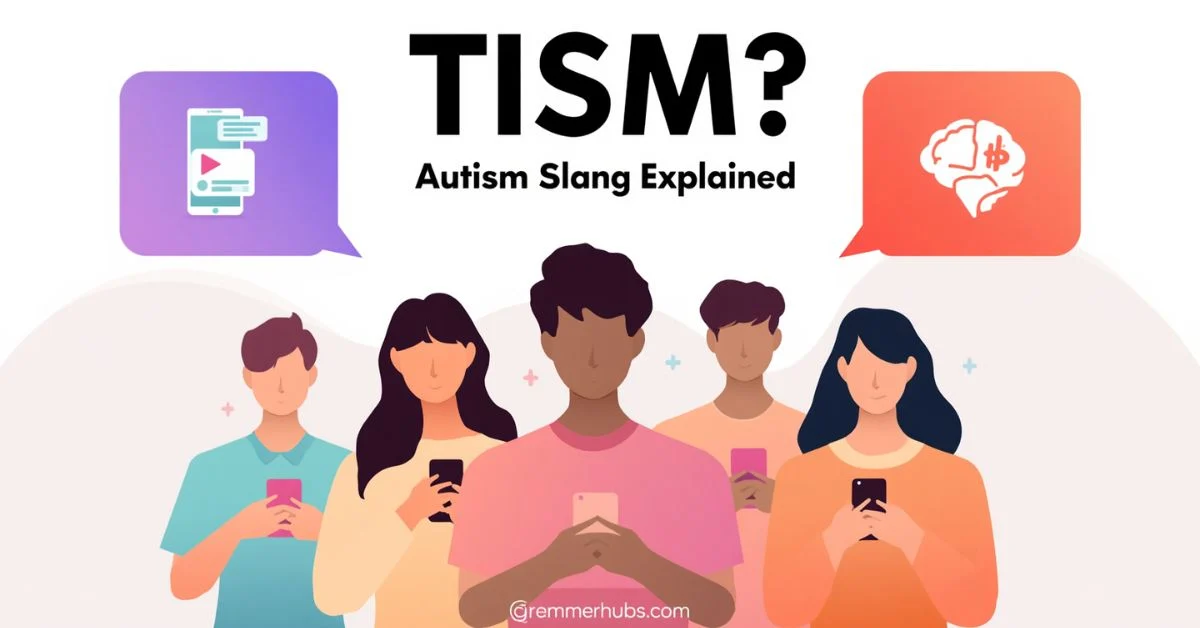
TISM is internet shorthand for autism, and people use it to poke fun at hyperfixations, blunt honesty, or an obsessive love of one very specific topic. If you’ve ever seen someone comment the tism is showing under a video of a guy explaining lawnmower engines for six straight minutes, that’s the word in action.
You’ll run into it on TikTok, in group chats, in Discord servers, and sometimes tucked into a dating app bio. And like a lot of slang that started inside a specific community, it doesn’t always travel well once it leaves that context. Some people use it warmly, about themselves. Others use it carelessly, about someone else and that’s usually where it stops being funny and starts being unkind.
So What Does Tism Actually Mean?
Tism is a clipped version of autism, used almost entirely as slang rather than in any clinical sense. When someone types it, they’re usually not talking about a diagnosis at all; they’re describing a behavior that reads as autism-coded: intense focus on a niche interest, a very particular routine, blunt or literal speech, or an inability to let a small detail go.
Here’s what that looks like in an actual text exchange:
Friend: why do you have 40 tabs open about medieval armor
You: it’s the tism, I physically cannot stop researching this
Nobody in that exchange is making a medical claim. The tism is standing in for something closer to my brain latched onto this and won’t let go which is exactly the kind of experience a lot of autistic and ADHD people describe when they talk about special interests or hyperfixations.
That’s the important nuance: the word gestures at a real, well-documented trait (intense, sustained interest in a topic), but it does so through humour rather than explanation. It’s less a definition and more a shared joke which is why it lands so differently depending on who’s telling it.
Where the Word Came From
Shrinking a clinical word down into slang isn’t a new move. People have done it with OCD, with trauma, and now with autism.
Tism specifically grew out of autistic and neurodivergent corners of the internet Reddit communities like autism and CasualAutism, Tumblr posts, and later a wave of TikTok creators who talked openly about being autistic. Inside those spaces, the term worked as a kind of reclaiming. Saying the tism won today felt lighter and more human than saying I had sensory overload and couldn’t leave the house.
From there it spread the way most niche internet language does:
It stayed mostly contained to those communities through the late 2010s. Then TikTok’s recommendation algorithm started surfacing autism and ADHD content to a much broader audience around 2021 and 2022, and words like tism, Neurospicy, and stimming rode along with it. By now, plenty of people use the term without ever having read a single post from the community it came from which is exactly why its meaning has gotten a little blurry at the edges.
How People Actually Use It
Context does a lot of heavy lifting with this word, so here’s what it sounds like in different places.
Texting between friends, it’s usually affectionate teasing:
he reorganized his spreadsheet for the third time today, the tism is undefeated
In a caption or comment section, it’s often self-aware humor:
POV: you can name every dinosaur but forgot your own phone number 💀 #tism
In gaming chats, it tends to describe obsessive game knowledge:
bro memorized every item drop rate in this game, that’s tism-coded behavior for
Said out loud, then repeated in a group chat, it’s almost always self-deprecating:
I alphabetize my spice rack, it’s giving tism and I’ve made peace with it
And within autistic communities specifically, it’s often a badge rather than an insult:
diagnosed at 27, yes the tism is real, no I will not stop talking about octopuses
NOBODY PUTS TISM IN A WORK EMAIL. 😎
Where People Get It Wrong
A few misunderstandings come up constantly, and they’re worth clearing up.
The biggest one is assuming the word is automatically an insult. It isn’t, at least not inherently. Inside neurodivergent spaces, it’s frequently self-referential a way of laughing about a shared experience rather than mocking it. Someone calling their own behavior the tism is very different from someone using the same word to make fun of a coworker.
The second mix-up is assuming only autistic people use it. That was true early on, but not anymore. Because the term went mainstream through memes, plenty of neurotypical people use it now without much thought about where it came from and that’s exactly the point where it can turn hurtful, since using it to describe someone else’s behavior carries a very different weight than using it about your own.
The third misconception is treating it as medically meaningful. It isn’t a diagnosis, and it shouldn’t be used to self-diagnose or to label someone else. It’s cultural shorthand born from a real community, not a clinical description.
What actually determines if the word lands as funny or hurtful comes down to three things: who’s speaking, who they’re speaking about, and why. Self-directed, it usually reads as lighthearted. Directed at someone else especially a stranger, or with a mocking edge it can genuinely sting.
Words People Use Alongside It
Tism rarely shows up alone. It travels with a small cluster of related slang that’s grown out of the same online spaces:
- Neurospicy a broader, gentler umbrella term covering ADHD, autism, and other forms of neurodivergence
- Autie a shortened, casual self-identifier for autistic, used mostly in community spaces
- Aspie an older term tied to the former Asperger’s diagnosis, now used less often
- Special interest the actual term autism research and community discussion uses for an intense, focused hobby
- Stimming repetitive movement or sound used for self-regulation, discussed often alongside tism
- Hyperfixation a shorter-term but equally intense focus on one thing, more common in ADHD contexts
Knowing these helps make sense of why tism doesn’t exist in a vacuum. It’s one piece of a whole vocabulary that grew up around people talking honestly about how their brains work.
If Someone Says It to You, How Do You Respond?
It really depends on your relationship with the person and where the conversation is happening
If you’re not sure what someone means by it, it’s completely fine to just say so: haha I’m not totally sure what that means but go off usually gets you an explanation without any awkwardness.
At work, or in any formal setting, the simplest move is to just not use the word yourself. If a colleague says it casually and it’s clearly not aimed at hurting anyone, you don’t need to make it a thing just respond to whatever they’re actually talking about.
Does It Show Up Outside English-Speaking Spaces?
Mostly, this is an English-language, internet-native term. It’s most common in the US, UK, Canada, and Australia, where autism-awareness content and neurodivergent creators have built a strong following on platforms like TikTok and Twitter/X. It hasn’t fully crossed into other languages yet, though as autism-related content spreads on global platforms, translated or locally-adapted versions are starting to pop up in non-English meme communities too.
Even within English, usage skews young. It’s a Gen Z and younger-millennial word, and it lives mostly on TikTok, Twitter/X, and Discord rather than older platforms like Facebook.
Tism vs. Similar Slang
| Term | Tone | Typically used by | Risk of causing offense |
| Tism | Casual, often self-deprecating | Neurodivergent users and general internet users | Depends heavily on context |
| Neurospicy | Light, inclusive | Broader neurodivergent community | Low |
| Autie / Aspie | Identity-based | People self-identifying as autistic | Low when self-applied, higher from outsiders |
| So OCD | Casual, often minimizing | General public | Medium to high |
On Dating Apps and in Online Communities
On Twitter/X and TikTok, tism shows up constantly in caption humor, often next to hashtags like #actually autistic or #Neurospicy. Reddit threads use it in a similar way: self-deprecating, community-driven, rarely aimed outward.
Dating apps are an interesting case. Some users put it directly in their bio as an upfront, confident bit of self-disclosure:
warning: big tism, will talk about vintage cameras for 45 minutes straight if you let me
That kind of bio is usually a conversation starter, not a warning label. If you match with someone who’s written something like that, leaning into curiosity tends to go over well something like okay I need to hear about how the camera works better than ignoring it or overexplaining that you understand what it means.
Gaming communities use it similarly Discord servers and Twitch chats will use tism to describe someone’s encyclopedic knowledge of a game, almost always as a compliment wrapped in a joke.
Where It Can Actually Be Hurtful
This is the part worth taking seriously instead of glossing over: tism absolutely can be offensive, and pretending otherwise does a disservice to the people it affects most. The exact same word can be affirming when an autistic person uses it about themselves, completely neutral in an offhand comment, or genuinely hurtful when it’s used to mock or exclude someone.
If you’re ever unsure how it’ll land, a reasonable rule of thumb is simple: don’t use it to describe someone else’s behavior unless they’ve already used it about themselves. Self-identification and outside commentary aren’t the same thing, even though the word on the screen looks identical either way.
Is It Ever Okay in Professional Settings?
No keep it out of work chats, emails, LinkedIn posts, or anything client-facing. It’s slang with real potential to offend, and it has no upside in a professional context.
If you’re trying to describe the underlying trait of intense focus, thoroughness, and deep knowledge of a subject without the slang, there are plenty of options.
Frequently Asked Questions
Does tism always refer to autism?
Yes the word comes directly from autism, though it’s almost always used casually rather than in any clinical sense.
Is it offensive to say tism?🫡
It depends entirely on context. Used by someone about their own traits, it’s usually accepted and even affectionate. Used to mock someone else, it can be genuinely hurtful.
Can I use it if I’m not autistic?
Be cautious about using it to describe someone else’s behavior unless they’ve invited that kind of joke. Using it about your own quirks is a more personal call.
What does big tism energy mean?
It’s an exaggerated way of saying someone is showing very obvious autism-coded traits, usually intense focus on a specific, often niche, topic.
How is tism different from neurospicy?
Neurospicy is broader and softer, covering various kinds of neurodivergence. Tism points specifically to autism.
Is this word used outside English-speaking countries?
Mostly not yet it’s largely confined to English-language internet spaces, though that’s slowly starting to change.
Should I use it with someone I just met?
Probably wait. It works best with people who already understand the tone and history behind it.Using it too early with someone new can easily be read the wrong way.
The Bottom Line
Tism started as an in-joke inside autistic and neurodivergent online communities and has since spread far beyond them, showing up in texts, captions, gaming chats, and dating app bios everywhere.
Used by someone to describe their own behaviour, it’s usually warm and self-aware. Used carelessly about someone else, it can cross a line fast and that line is exactly what makes this word worth understanding rather than just repeating.
If there’s one thing worth remembering, it’s this: context and intent decide everything here. Who’s speaking, who they’re speaking about, and why they’re saying it will tell you far more than the word itself ever could. And when in doubt especially anywhere professional it’s just not worth the risk.
Read More About!
Suh Mean? A Quick, No-Fluff Answer. Why It Matters
Ick Meaning in Text 😬 Instant Turn-Off Slang Explained
Awh in Texting: in Dating Apps & Everyday Slang

I’m Emma Reynolds, and I live and breathe everyday slang at GrammerHubs.com. I love breaking down the weird, short ways we text each other. No boring grammar lessons here, just real talk about how we actually chat.