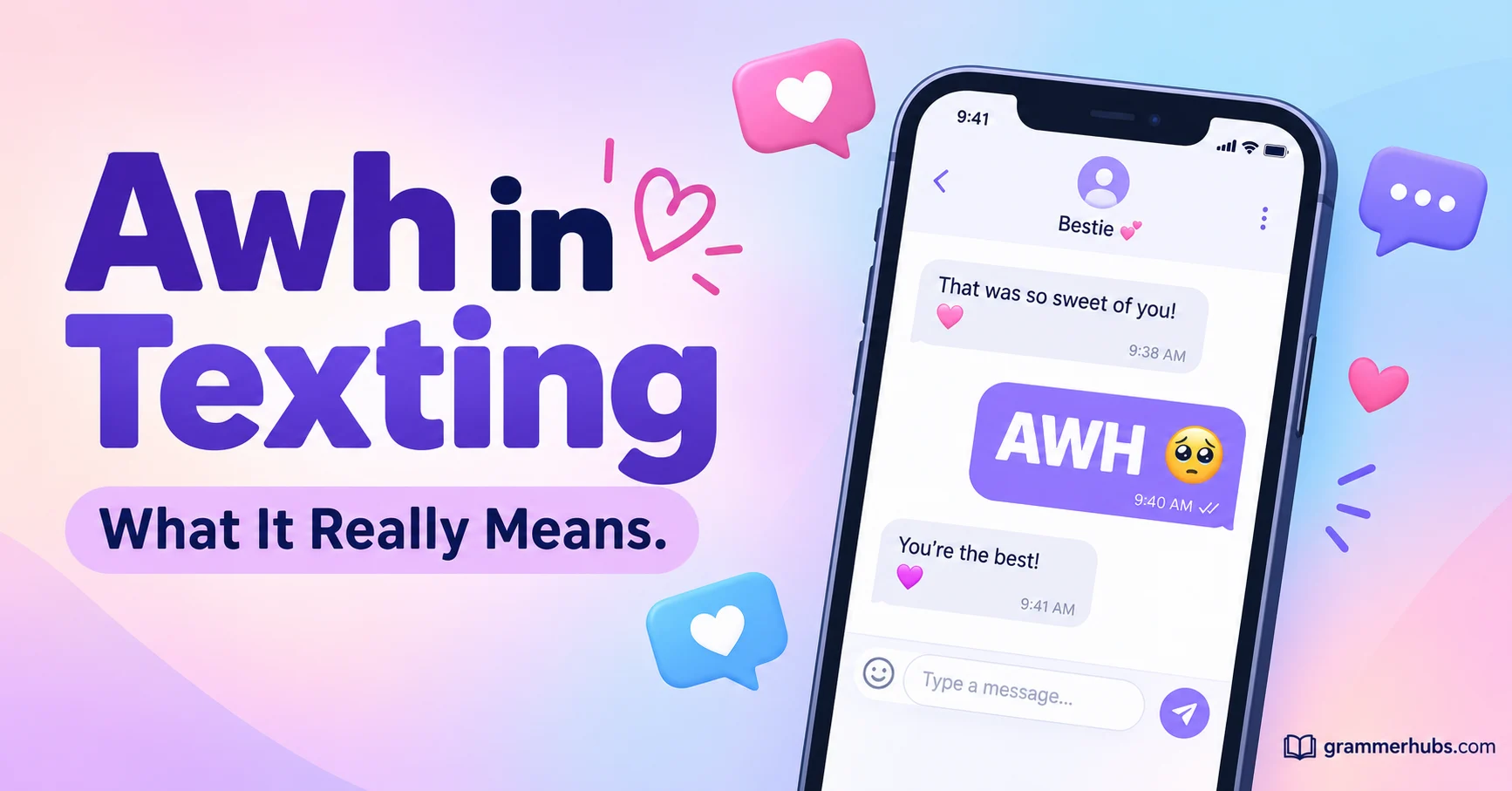
AWH is a soft, affectionate reaction, a texting version of the sound people naturally make when something is sweet, sad, or touching. Think of it as a written sigh: warm, quick, and easy to read. the strange power of small texting words.
A single reaction like Awh can carry more feeling than a full sentence, which is exactly why it shows up everywhere: text threads, Instagram comments, dating app messages, gaming chats, even the occasional work Slack channel when someone shares a picture of their new-born plenty of people still pause over it. Does it mean something different coming from a guy versus a girl? Is it flirty? Is it just aww spelled differently, or is there more going on?
What Awh Actually Means
Awh is an interjection, a short burst of language that reacts emotionally rather than explaining anything. It sits in the same family as aww and aw, and in casual writing, all three are used almost interchangeably.
- Awh / aww a soft, affectionate or sympathetic reaction
- Aw the shorter, more clipped version, often used before a complaint (aw, come on)
- Awe a completely different word, meaning wonder or amazement, and not really part of this group at all
The spelling with an h at the end is a texting habit more than a rule. Stretching or reshaping a word sooo, noooo, awh is just how people add emotional weight in writing when they can’t rely on tone of voice. Awh does that same job.
What makes it genuinely useful is that it flexes with context. The exact same word can mean two very different things:
Priya: My roommate left cookies on my desk with a sticky note. Dan: awh that’s so sweet
Priya: I found out my flight got cancelled and I’m stuck at the airport overnight. Dan: awh no, I’m so sorry
Same word, opposite emotional weather. One is pure sweetness, the other is comfort. That range is the whole reason awh survives in everyday texting; it’s a oneword tonesetter, and the reader fills in the rest from context.
Where the Word Came From
There’s no single, documented moment where awh was invented and honestly, any article that claims otherwise is guessing. What’s more accurate is this: the sound it’s based on (aww) is a natural human reaction, the kind of noise people make involuntarily when they see something adorable or hear something touching. That sound existed long before texting did.
As instant messaging and early social platforms took off in the 2000s, people needed a written standing for that sound, and aww became the common version. Awh is a later variation, part of a broader pattern in informal writing where people stretch or rearrange spelling for effect rather than correctness the same instinct behind sooo good or literally cannot.
It’s fair to say the word has become more visible alongside the rise of shortform platforms like TikTok and Instagram, where fast, low effort emotional reactions in comment sections are the norm. But treating that as a precise origin story would be overstating it. Slang rarely has a clean birth certificate; it spreads sideways, through group chats and comment sections, long before anyone tracks where it started.
How People Actually Use It
The core meaning barely changes from platform to platform. What shifts is the setting and sometimes the pacing.
In one on one texting, it usually responds to something personal:
Maya: I made you a playlist for your drive tomorrow. Josh: awh you didn’t have to do that 🥺
In social media comments, it’s often quick and public:
Comment on a video of a toddler falling asleep midsentence: awh he fought so hard to stay awake 😭
In gaming chats, it can soften an otherwise ordinary moment:
Player: Sorry, gotta go to my cat’s demanding attention. Teammate: awh give him a scratch for us
In everyday conversation over text, it often shows support:
Friend: I finally finished my first 10k! You: awh that’s amazing, I’m so proud of you
Across all of these, awh is doing quiet work: it tells the other person I felt something reading that, without requiring a longer reply. That’s especially valuable in fast moving conversations, where a full sentence can feel like more effort than the moment calls for.
Common Misunderstandings, Cleared Up
A few ideas about awh get repeated so often that people assume they’re rules. They’re not quite right.
It’s often assumed that awh only means something is cute but it also covers sympathy, comfort, or mild letdown, depending on what came before it. Someone might use it after a compliment or after bad news, and the meaning shifts entirely based on context, not the word itself.
Some people also treat awh and aww as different words with different meanings. In practice, they’re the same reaction with different spelling habits; no meaningful distinction exists between them.
There’s also an assumption that awh is inherently flirty. It isn’t, by default. It’s warm, but warmth and romantic interest aren’t the same thing. Two close friends can say awh to each other constantly with zero romantic undertone.The surrounding relationship and conversation decide that, not the word.
One more thing worth knowing: tone is fragile with a word this short. Awh. with a flat period can read as distant or even a little sarcastic. Awhh 🥺 reads as genuinely warm. The punctuation and emoji around it often carry more meaning than the word itself which is worth remembering before sending it in a message where the tone really matters.
Words That Mean Something Similar
| Term | What it usually signals | Where it fits best |
| Aww | Same as awh, more standard spelling | Texting, comments |
| Aw | Shorter, sometimes paired with mild complaint | Casual texting |
| Awe | Wonder or amazement different meaning entirely | Formal or descriptive writing |
| So cute / so sweet | A direct, unambiguous compliment | Texting, comments |
| Bless | Sympathy, sometimes with a touch of humor | Casual conversation |
| 🥺 emoji | Softness or pleading, often paired with awh | Texting, replaces or reinforces the word |
How to Respond to It
There’s no single correct reply, the right one depends on who’s texting and what mood the conversation is in.
If it’s casual: haha I know right keeps things light without overthinking it.
If you want to be a little playful: okay but did you actually tear up invites more conversation instead of ending it flat.
If the moment calls for warmth back: you’re too sweet, thank you matches the tone rather than deflecting it.
If it comes up in a lightly professional chat with a close coworker, not a client, a simple thanks, appreciate that it works fine without feeling stiff.
And if the topic feels a bit too personal to dig into right then: haha thanks, I’ll tell you more later and buy space without shutting the conversation down.
The general rule: match the energy. A warm awh landing flat with a one word reply can read as disinterest, even when that’s not the intent.
Does It Show Up Outside English?
Awh itself is an English language habit, most common across the US, UK, Canada, and Australia. That said, the impulse behind it isn’t unique to English at all; plenty of languages have their own short, instinctive sounds for reacting to something touching or sweet. The exact words differ by language and region, and it’s worth being cautious about treating any of them as a direct onetoone translation of awh the emotional function is similar, but the words carry their own cultural weight and aren’t interchangeable.
What does travel well is the idea: a short, low effort reaction that says I felt that, without needing a full sentence to prove it.
Awh on Dating Apps and Social Platforms
On apps like Tinder or Hinge, and on platforms like Twitter/X, awh works as a low risk way to show interest without overcommitting emotionally in a single message.
Match: I still have the stuffed rabbit my dad won me at a carnival when I was seven. You: awh, that’s actually really sweet you still have it after all this time?
That kind of reply does two things: it acknowledges the emotional beat, then follows up with a question, which keeps the conversation moving instead of letting it die in a single word.
On Twitter/X, it often shows up under personal, relatable posts:
Post: My mom texted ‘proud of you’ completely out of nowhere today. Reply: awh moms really do that when you least expect it
The pattern worth remembering: awh alone is a fine reaction, but pairing it with a followup question or observation is what actually keeps a conversation alive especially in the early stages of a dating app chat, where momentum matters.
Is There a Hidden or Negative Meaning?
For the most part, no awh is one of the more harmless pieces of texting slang out there. There’s no offensive or hidden meaning baked into the word itself.
Where it can go sideways is tone. Said sarcastically awh, poor you it can come across as mocking or dismissive rather than sympathetic. That shift almost always comes from context and delivery, not the word itself. If a conversation already has some tension in it, awh without softening (an emoji, an exclamation point, a followup) can land harder than intended.
Does It Belong in Professional Messages?
Generally, NO. Awh is built for casual, personal conversation, and it doesn’t carry the same weight in formal or clientfacing communication.
In a close knit team chat between coworkers who already text casually, it’s harmless. In an email, a report, or a message to a client, it reads as too informal and can undercut a professional tone. For those settings, a few alternatives do the same emotional job without the casualness:
- That’s wonderful to hear.
- I really appreciate you sharing that.
- That’s a lovely story, thank you for telling me.
These keep the warmth of the original reaction while staying appropriate for a more formal setting.
Frequently Asked Questions
What does awh mean from a guy?
Usually the same as it would from anyone: genuine warmth, sympathy, or affection. It isn’t automatically romantic the surrounding conversation determines that.
What does awh mean from a girl?
The same core meaning applies. Context and relationship history shape the tone more than gender does.
Is awh the same as aww?
Yes. The spelling differs slightly, but the meaning is the same.
Can awh be sarcastic?
Yes, particularly without warm punctuation or emojis, or right after something a little eyerollworthy.
Is awh flirty?
It can be, depending on who’s saying it and what’s already going on between you two but it isn’t flirty by default.
Is it okay to use awh at work?
Only in casual chats with close coworkers. It’s not suited for client communication or formal writing.
What emoji pairs best with awh?
🥺, ❤️, and 😭 are the most common each nudging the tone slightly toward pleading, affection, or emotional overwhelm.
The Bottom Line
Awh is a small word doing a big job: it lets people signal warmth, sympathy, or affection without slowing a conversation down. Its meaning bends with context, sweet in one message, comforting in the next which is exactly why it’s stuck around across texting, social media, gaming, and dating apps.
The word itself isn’t the tricky part; tone, punctuation, and timing are what actually shape how it lands. Once you can read those cues, Awh stops being confusing and starts being what it was always meant to be a quick, honest way of saying I felt that.
Discover More About!
What Does GH Mean in Text? Real Answer
Suh Mean? A Quick, No-Fluff Answer. Why It Matters
Ick Meaning in Text 😬 Instant Turn-Off Slang Explained

I’m Emma Reynolds, and I live and breathe everyday slang at GrammerHubs.com. I love breaking down the weird, short ways we text each other. No boring grammar lessons here, just real talk about how we actually chat.






1 thought on “Awh in Texting: in Dating Apps & Everyday Slang”