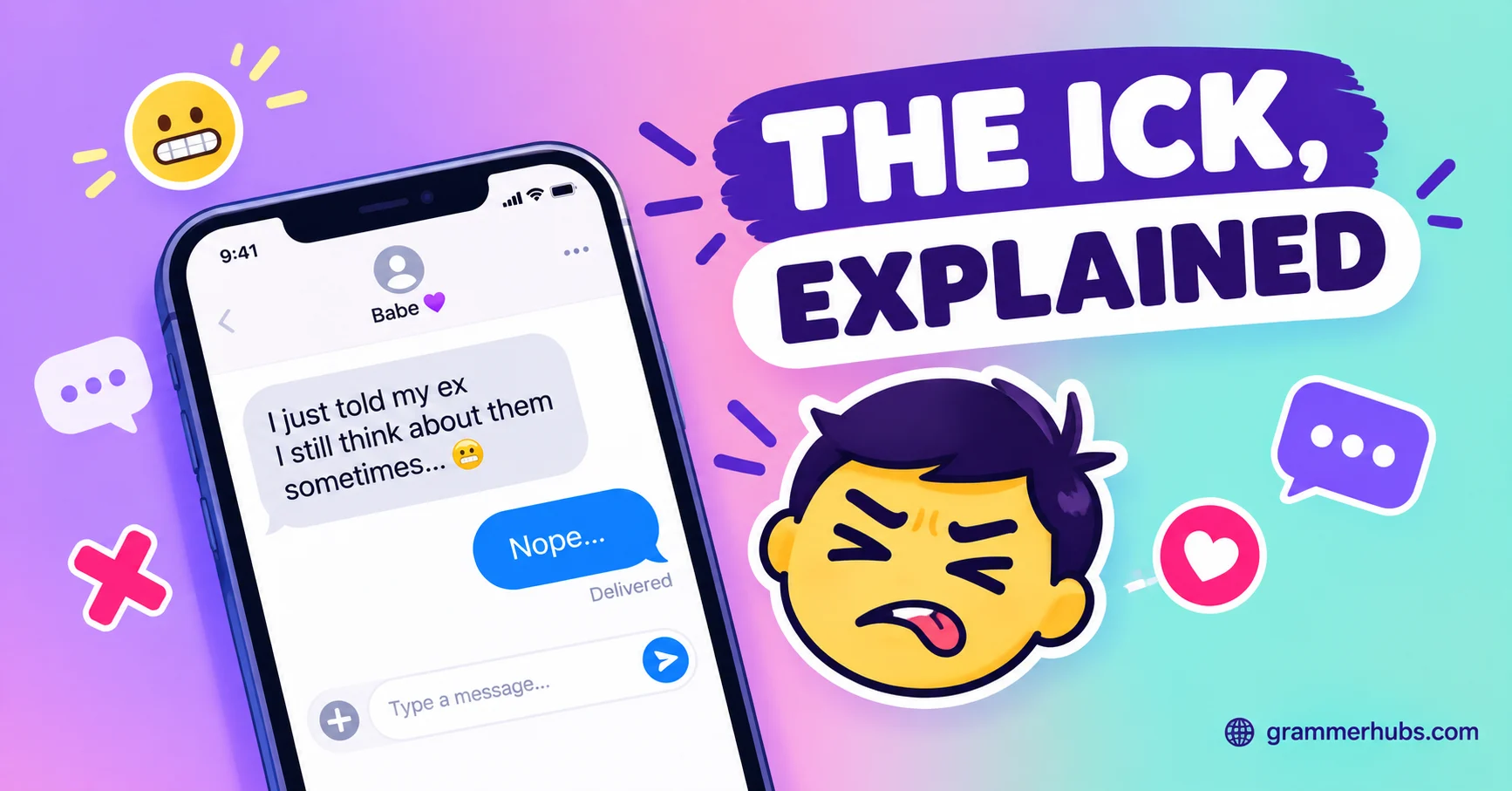
Someone you liked texts you back. Nothing’s technically wrong with the message. But you read it and feel your stomach do a small, involuntary flip of disgust. That’s the ICK and if you’ve ever tried to explain it to someone who’s never felt it, you already know how hard it is to put into words.
In short: the ICK is a sudden, often irrational wave of disinterest toward someone you were previously into, usually triggered by one small, specific thing they did.
It’s not a verdict on their character. It’s closer to a gut reflex quICK, hard to justify, and almost impossible to argue yourself out of once it hits.
The word has spread from reality TV green rooms into group chats, dating app bios, TikTok comment sections, and more than a few of us will admit the occasional office Slack. This piece breaks down where it came from, how people actually use it in texts and online, and where the line sits between harmless slang and actually kind of unkind.
The Actual Meaning, Not the Textbook One
The ICK isn’t about someone doing something wrong. It’s about your brain quietly deciding it’s done, usually over something too small to hold up in an argument, a laugh that hits wrong, a way of typing, a specific word choice you can’t unsee.
In a group chat, it tends to sound like this:
he texted heyyy with five y’s and I felt the ICK crawl up my spine she apologized for a joke I didn’t even think was bad. huge ICK. He typed lol after his own message. that’s it. That’s the ICK.
Grammatically, it’s flexible in a way most slang isn’t. You can have the ICK (I have the ICK), someone can give you the ICK (he’s giving me the ICK), or you can just fire it off on its own as a reaction no sentence required. That flexibility is part of why it caught on so fast. It does a lot of emotional work for three letters.
Where the Word Actually Came From
ICK as a general word for gross has been around for decades kids have said it forever. The dating-specific version is newer, and its origin is genuinely traceable, which is rare for internet slang.
Most language writers point to British reality dating shows from the 2010s, where contestants would describe getting the ICK about a partner over hyper-specific behavior: how they ate, how they danced, what they wore. Merriam-Webster’s slang coverage and several UK entertainment outlets trace the modern usage back to this scene, and it stayed fairly niche until TikTok pICKed it up.
Once things that give me the ICK compilations started pulling in millions of views, the term jumped from reality-TV fan spaces into everyday texting vocabulary almost overnight. Dating forums and Twitter threads pICKed it up next, and within a couple of years it had drifted well past dating. People now say they got the ICK from a coworker’s email sign-off or a friend’s caption choice.
That’s roughly the lifecycle of a lot of slang: something specific, amplified by short-form video, that eventually loosens up enough to fit almost any mildly cringe moment.
How It Actually Shows Up, Depending on Where You Are
The tone shifts depending on the setting, even though the core meaning stays the same.
Between friends over text, it’s usually a quICK, half-joking verdict:
I just landed! lmk you got home safe too 🥺 not me getting the ICK from a single emoji lol
On social media, it often rides along with a viral list. Someone quote-tweets the way he says ‘we should’ instead of asking, ICK and the replies fill up with SAME and why is this so specific.
In gaming chats, people borrow it more loosely, usually aimed at teammates rather than romantic interests:
he typed gg ez after we barely scraped a win. instant ICK.
In everyday conversation, it often functions as the closing line on a debate about If someone’s a good match:
He was sweet all night, but the second he called his mom mommy in front of me, I was out. ICK.
Across all of these, the common thread isn’t the setting, it’s that the person saying it isn’t asking for permission to feel that way. That’s part of the appeal. It doesn’t require justification, and demanding one usually kills the joke.
The Two Things People Keep Getting Wrong
A couple of misconceptions come up constantly, and they’re worth untangling.
The first is treating an ICK like it means something’s seriously wrong. Usually it doesn’t. Most ICKs are small, subjective, and honestly a little unfair to the person on the receiving end. That’s part of what people find funny about naming them out loud.
The second is confusing an ICK with a red flag. They’re not doing the same job. A red flag points to an actual concern: dishonesty, disrespect, controlling behavior, something with real stakes. An ICK is closer to an aesthetic flinch: a laugh, a walk, a texting habit that just doesn’t land, with no deeper claim attached.
Where it gets murkier is when someone directs an ICK at something a person can’t change their body, their voice, their accent, their background. At that point it stops being a lighthearted texting joke and starts being something closer to a put-down wearing slang as a disguise. The word itself isn’t the problem. What it’s aimed at is.
How ICK Compares to Similar Slang
| Term | What it signals | Weight |
| The ICK | A small behavior causes sudden disinterest | Light often forgotten within a day |
| Red flag | A real warning sign about someone’s character | Serious |
| Cringe | Secondhand embarrassment, not necessarily disinterest | Light |
| Turnoff | A broader, older term for anything unattractive | Light to moderate |
| Green flag | The opposite a trait that makes someone more appealing | Positive |
The distinction worth remembering: an ICK is about a feeling, a red flag is about evidence. People blur the two in casual conversation, but they’re built to describe different things.
If Someone Says It to You, Here’s How to Respond
How you respond depends on the relationship and how seriously the other person means it.
With a close friend, curiosity works best: wait what did he do 😭 With someone who’s clearly joking, matching the energy lands better than analyzing it: say less, what was it this time, the walk or the laugh? In a lighter professional setting, say, a coworker who already texts casually a dry, brief acknowledgment does the job: noted, moving on. And if you’d rather not get into it, there’s nothing wrong with keeping it vague: eh, just a vibe thing, not worth explaining.
The one response to avoid is treating it like a formal accusation that needs a rebuttal. It’s throwaway slang. Meeting it with a serious lecture tends to make the moment more awkward, not less.
Is This a Global Thing, or Mostly English-Speaking Internet?
ICK is largely an English-language, internet-driven term, strongest right now in the US, UK, and Australia. Its dating-specific meaning is widely credited to British reality TV and spread outward from there through short-form video.
That doesn’t mean the feeling is new elsewhere. Plenty of languages already have their own casual phrase for that gave me a weird feeling the sensation isn’t culturally exclusive, just the specific word. What’s newer is this particular three-letter term getting pICKed up wholesale into other languages’ online slang, the same way a lot of English internet terms get absorbed rather than translated. If you hear a non-English speaker drop ICK mid-sentence, that’s usually exactly what’s happening.
Where You’ll Actually Run Into It
On apps like Hinge, Bumble, and Tinder, tell me your weirdest ICK has become a fairly standard icebreaker prompt in bios. On X (formerly Twitter), it tends to show up attached to viral list-threads that people quote with their own additions. In gaming spaces, it’s used more loosely aimed at teammate behavior rather than romantic prospects.
If someone brings it up early in a match conversation, it’s usually meant as a light, low-stakes reveal rather than a real accusation. A playful answer tends to land better than a defensive one.
Does It Ever Mean Something Harsher?
On its own, no. It’s short for disgust, and that’s it there’s no hidden or offensive origin to the word itself.
Where it gets complicated, again, is the target. Aimed at a texting habit or an outfit choice, it’s harmless. Aimed at someone’s body, race, disability, or identity, it’s no longer really about the ICK it’s using the slang as cover for something meaner. The word doesn’t carry that weight on its own. The person using it decides If it does.
Does It Belong in Professional Writing?
Generally, no. It’s casual slang, and dropping it into an email, a report, or anything client-facing will read as out of place, possibly even confusing to someone unfamiliar with it.
If you need the same idea in more formal language, these hold up better:
- That didn’t sit right with me.
- I found that off-putting.
- That wasn’t quite the right fit.
It’s fine in a Slack message between coworkers who already text like that. It’s not fine in anything meant for a wider or more formal audience.
Frequently Asked Questions
What does ICK mean in a text message?
It’s a sudden feeling of disgust or disinterest toward someone, usually triggered by something small and specific rather than a real issue.
Is the ICK the same as a red flag?
Not really. A red flag signals a genuine concern about someone’s character. An ICK is more of a reflex reaction to a small habit or mannerism.
Where did the ICK come from?
It’s widely traced to British reality dating shows in the 2010s, then spread globally once TikTok pICKed it up.
Can you get over an ICK?
Sometimes. Smaller ones often fade once you get to know someone better. Others stICK around and quietly end the connection.
Is it okay to use ICK at work?
Only casually, with coworkers you already text informally. It doesn’t belong in anything formal or client-facing.
Is ICK an offensive word?
Not by itself. It becomes a problem only when it’s aimed at something someone can’t change, like their appearance or identity.
What’s the opposite of an ICK?
A green flag is a small trait that makes someone more appealing rather than less.
The Bottom Line
The ICK started as a specific bit of reality-TV slang and turned into shorthand for something that used to take a full paragraph to explain: I don’t know why, but I’m suddenly not into this anymore. It shows up in texts, dating bios, gaming chats, and everyday conversation, always doing the same basic job of naming a feeling instead of justifying it.
It’s not scientific, and it’s rarely fair to whoever’s on the receiving end. But it’s useful precisely because it’s so quICK.
Now that you know where it came from and how people actually use it, you’ll probably catch your next ICK before anyone has to explain the joke.
Discover Other Posts!
SYM Mean In Text? 🤫 The Real Meaning
What Does GH Mean in Text? Real Answer
Suh Mean? A Quick, No-Fluff Answer. Why It Matters

I’m Emma Reynolds, and I live and breathe everyday slang at GrammerHubs.com. I love breaking down the weird, short ways we text each other. No boring grammar lessons here, just real talk about how we actually chat.





2 thoughts on “Ick Meaning in Text 😬 Instant Turn-Off Slang Explained”