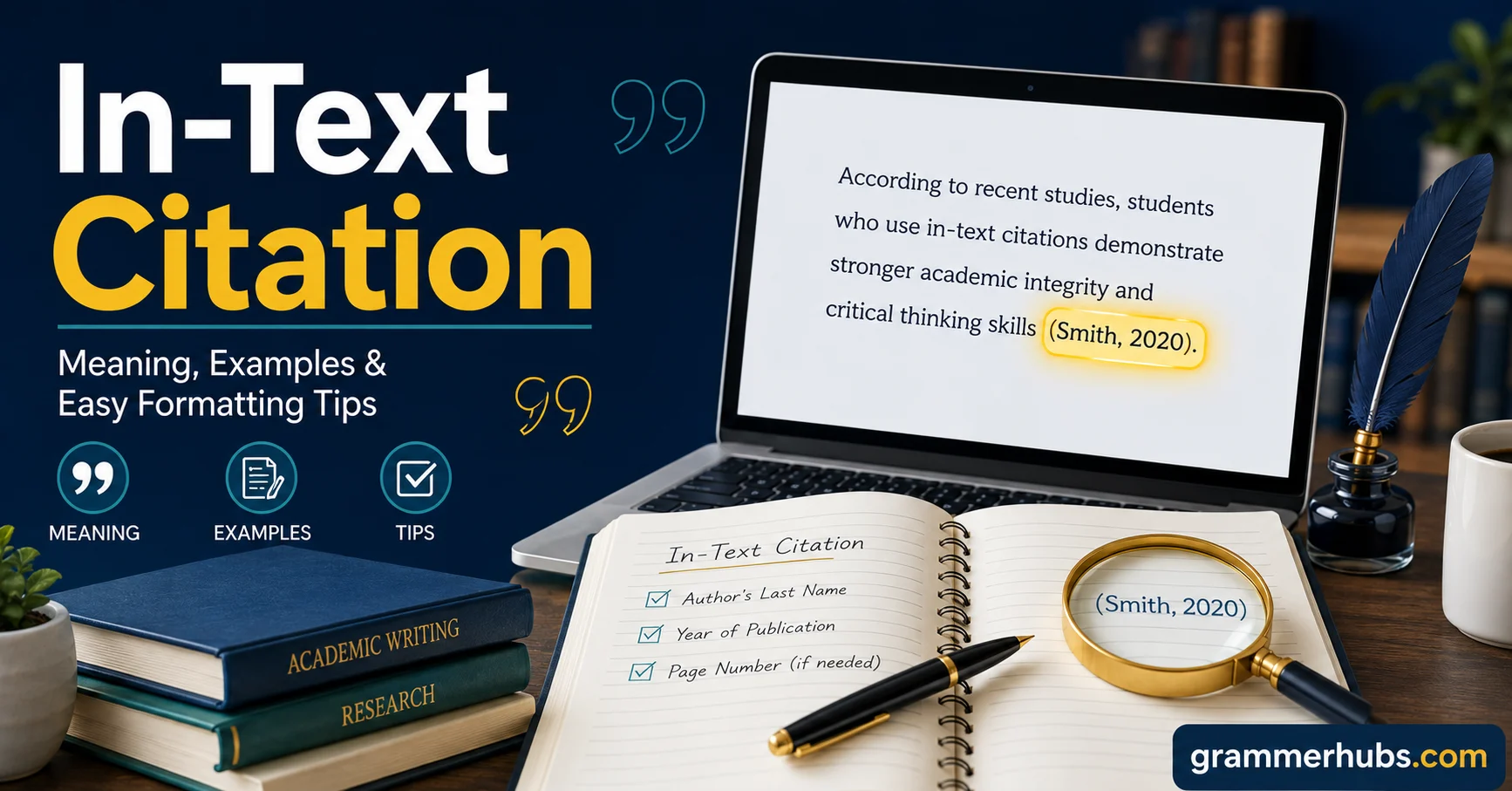
An in-text citation is a short note inside your essay, usually an author’s name and a year or page number, like (Smith, 2020) that tells readers exactly where a fact, quote, or idea came from. It’s the small tag that connects your sentence to the full source listed in your reference list or bibliography.
You’re halfway through an essay, you’ve just dropped a great quote, and your professor’s rubric says: in-text citations required. Panic sets in for exactly three seconds. Then you realize it’s simpler than it sounds.
Every day, students, bloggers, journalists, and researchers use in-text citations without thinking twice about the term itself. It shows up in Google Docs comments, Grammarly suggestions, Turnitin reports, and every citation generator you’ve ever clicked through in a caffeine-fueled study session at 1 a.m.
Understanding this one concept, what it means, why it matters, and how to actually use it is the difference between a paper that reads as credible and well-researched and one that gets flagged for plagiarism.
Let’s break it down in plain English.
Definition & Meaning
An in-text citation is a brief reference placed directly within the body of your writing, right after a borrowed idea, fact, quote, or paraphrase. It points the reader to the full source, which lives in your reference list, works cited page, or bibliography at the end of the document.
Think of it as a small breadcrumb. The full trail (author, title, publisher, date) is saved for later; the in-text version just marks the spot where you used someone else’s work.
A typical in-text citation includes some combination of:
- The author’s name
- The publication year
- A page number or paragraph number (for sources without pages, like websites)
Examples in real use:
- APA style: Motivation drives long-term learning outcomes (Carter, 2019).
- MLA style: Motivation drives long-term learning outcomes (Carter 45).
- With a signal phrase: According to Carter (2019), motivation drives long-term learning outcomes.
Notice the pattern of a short tag, tucked right where the idea appears, that doesn’t interrupt the flow of the sentence but still gives credit where it’s due.
Background & History
Citation itself is when ancient scholars have referenced other scholars’ work for centuries. But the standardized, bracketed in-text citation format most people recognize today grew out of 20th-century academic publishing, when disciplines like psychology, science, and law needed a fast, consistent way to credit sources without cluttering pages with long footnotes.
The APA style (developed by the American Psychological Association) formalized author-date citations in the 1920s to help scientific writing stay concise. The MLA style, favored in the humanities, leaned toward author-page citations instead, since page numbers matter more when analyzing literature. Meanwhile, Chicago style and Turabian kept both footnote and author-date options alive for history and research-heavy fields.
Fast forward to today: in-text citations are baked into word processors, citation generators, and academic databases. What used to be a manual, error-prone task flipping through style guides is now often a single click, thanks to tools like Zotero, Mendeley, and EndNote. The concept hasn’t changed much, but the speed and accessibility of using it correctly has completely transformed.
Usage in Various Contexts
In-text citations aren’t just for stiff research papers. They show up anywhere someone needs to prove a claim isn’t just their opinion.
In academic essays:
As one study notes, sleep deprivation reduces memory retention (Lee, 2021).
In professional reports:
Market growth is projected at 8% annually (Global Insights, 2023).
In blog posts and journalism:
According to a 2023 Pew Research survey, most adults check their phones within ten minutes of waking up.
In student conversation (informally):
Student A: Did you cite that stat about screen time? Student B: Yeah, I dropped an in-text citation right after the sentence so I don’t lose points.
In casual online discussion (forums, study groups):
Don’t forget your in-text citation goes before the period, not after that one always trips people up.
The core idea stays the same across every setting: credit the source, right where the borrowed idea appears, so the reader never has to guess where information came from.
Common Misconceptions & Clarifications
A few myths trip people up constantly:
Myth 1: If I paraphrase, I don’t need to cite it. False. Paraphrasing still requires an in-text citation you’re using someone else’s idea, just in your own words.
Myth 2: One citation at the end of the paragraph covers everything. Not quite. If multiple sentences use the same source, most style guides still expect citation at the sentence or claim level, especially when you switch sources mid-paragraph.
Myth 3: In-text citation and bibliography are the same thing. They’re partners, not twins. The in-text citation is the short in-sentence marker; the bibliography (or reference list) is the full, detailed entry at the end of the document.
Myth 4: Citing too much makes my writing look weak. Actually, the opposite is true. Solid, well-placed citations boost your credibility and authority as a writer they show your claims are backed by real evidence, not guesswork.
Getting these details wrong isn’t offensive, but it can cost you grades or professional credibility, so it’s worth clarifying early.
Similar Terms & Alternatives
Several related terms get used interchangeably, but they aren’t quite the same thing.
| Term | What It Means | How It Differs |
| In-text citation | Short reference within the sentence/paragraph | Points to the full source |
| Parenthetical citation | Citation placed in parentheses | A common style of in-text citation |
| Footnote/Endnote citation | Reference placed at bottom of page or end of document | Alternative to parenthetical style (used in Chicago/Turabian) |
| Reference list / Works Cited | Full alphabetical list of sources | Comes at the very end of the paper |
| Bibliography | Complete list of everything consulted, cited or not | Broader than a reference list |
| Signal phrase / narrative citation | Naming the author directly in the sentence | A variation of in-text citation, e.g., Carter argues that… |
Knowing these distinctions helps you follow instructions precisely when a professor or editor asks for a specific format.
How to Respond to Feedback About Citations
If someone flags your writing for missing or incorrect in-text citations, your response style depends on the setting.
Casual (peer review or study group):
Oh good catch I’ll drop the page number in there.
Funny (friend proofreading your draft):
Guilty. I wrote that fact from memory and hoped nobody would ask.
Professional (responding to an editor or supervisor):
Thank you for flagging this. I’ll add the appropriate in-text citation and confirm the source in the reference list.
Detail-conscious (when accuracy really matters):
I’ll double-check the original source and update the citation format to match APA 7th edition.
Matching your tone to the audience keeps the conversation smooth, If you’re texting a classmate or emailing a client.
Regional or Cultural Differences
Citation habits vary more by academic discipline and country’s education system than by culture directly, but there are patterns worth knowing:
- United States: APA (social sciences), MLA (humanities), and Chicago (history/publishing) dominate.
- United Kingdom and Australia: Harvard referencing is extremely common across universities.
- Medical and scientific journals worldwide: Vancouver style or AMA style is standard.
- Engineering and computer science globally: IEEE citation style is the norm.
So while the concept of an in-text citation is universal, the exact format parentheses vs. superscript numbers, author-date vs. numbered shifts depending on your field and where you’re studying or publishing.
Usage in Online Communities
On platforms like Reddit’s r/college or r/AskAcademia, student Discord servers, and academic Twitter (X), in-text citation is a frequent topic usually in threads asking for help with formatting, or memes joking about last-minute citation panic before a deadline.
Example thread reply:
Just use a citation generator, paste the in-text citation after your quote, and move on. Don’t overthink it.
Even outside classrooms, freelance writers and content marketers discuss in-text citations when talking about E-E-A-T (Experience, Expertise, Authoritativeness, Trustworthiness) , a framework Google’s algorithm increasingly rewards. Articles that clearly cite credible sources tend to signal stronger user intent match and topical authority, both of which influence how well content ranks in search results.
Hidden or Alternative Meanings
Good news: in-text citation has no hidden, slang, or offensive meaning. Unlike a lot of internet terminology, this one is purely academic and professional. The only real misuse risk is applying the wrong style guide for your field, which isn’t offensive, just a formatting mismatch worth fixing before submission.
Suitability for Professional Communication
In-text citations are not just suitable for professional writing; they’re often required in reports, whitepapers, journalism, legal writing, and academic publishing. If you’re writing something less formal, like a casual blog post, you can soften the language:
- Formal: (Carter, 2019)
- Softer alternative: as Carter notes in a 2019 study…
- Very casual: there was actually a study on this back in 2019 (best paired with a linked source instead of a formal citation)
When in doubt, match the citation style to the formality of the piece you’re writing.
FAQs
1. What is the simplest definition of an in-text citation?
It’s a short note within your writing, usually an author and date that shows where an idea or quote came from.
2. Is an in-text citation the same as a footnote?
Not exactly. A footnote is one method of citing sources at the bottom of the page; an in-text citation typically appears in parentheses within the sentence itself.
3. Do I need an in-text citation for paraphrased information?
Yes. Paraphrasing still borrows someone else’s idea, so it still needs credit.
4. What happens if I forget an in-text citation?
It can be flagged as plagiarism, even if unintentional, so it’s worth double-checking every borrowed fact or quote.
5. Which citation style should I use?
It depends on your field: APA for social sciences, MLA for humanities, Chicago for history, and IEEE or Vancouver for technical and medical fields.
6. Can I use a citation generator for in-text citations?
Yes, tools like Zotero, Mendeley, and EasyBib can generate accurate in-text citations and full reference entries quickly.
7. Where does the in-text citation go in a sentence?
Usually right after the borrowed information, before the closing punctuation, e.g., …as shown in recent data (Lee, 2021).
Conclusion
An in-text citation is simply a short signal author, year, or page placed right where you use someone else’s idea, connecting your writing to its original source.
It matters in classrooms, newsrooms, offices, and even casual online discussions, because it protects your credibility and keeps your work honest. If you’re following APA, MLA, Chicago, or Harvard style, the goal is always the same: give credit clearly, right where it’s due.
Once you understand the pattern, using in-text citations correctly becomes second nature no more 1 a.m. panic required.
Read More Posts!
What Does NM Mean In Text? Real Answer + Examples
How to Emphasize Meaning in Text: Bold, Italics & Tone Tricks
Exclamation Mark Mean in Text? Decode the Real Tone

I’m Chloe Mitchell, a passionate writer at Grammerhubs.com specializing in English grammar, word meanings, slang terms, and modern language trends. I create clear, engaging, and easy-to-understand content that helps readers master everyday English with confidence.










2 thoughts on “In-Text Citation? Meaning, Examples & Easy Formatting Tips”