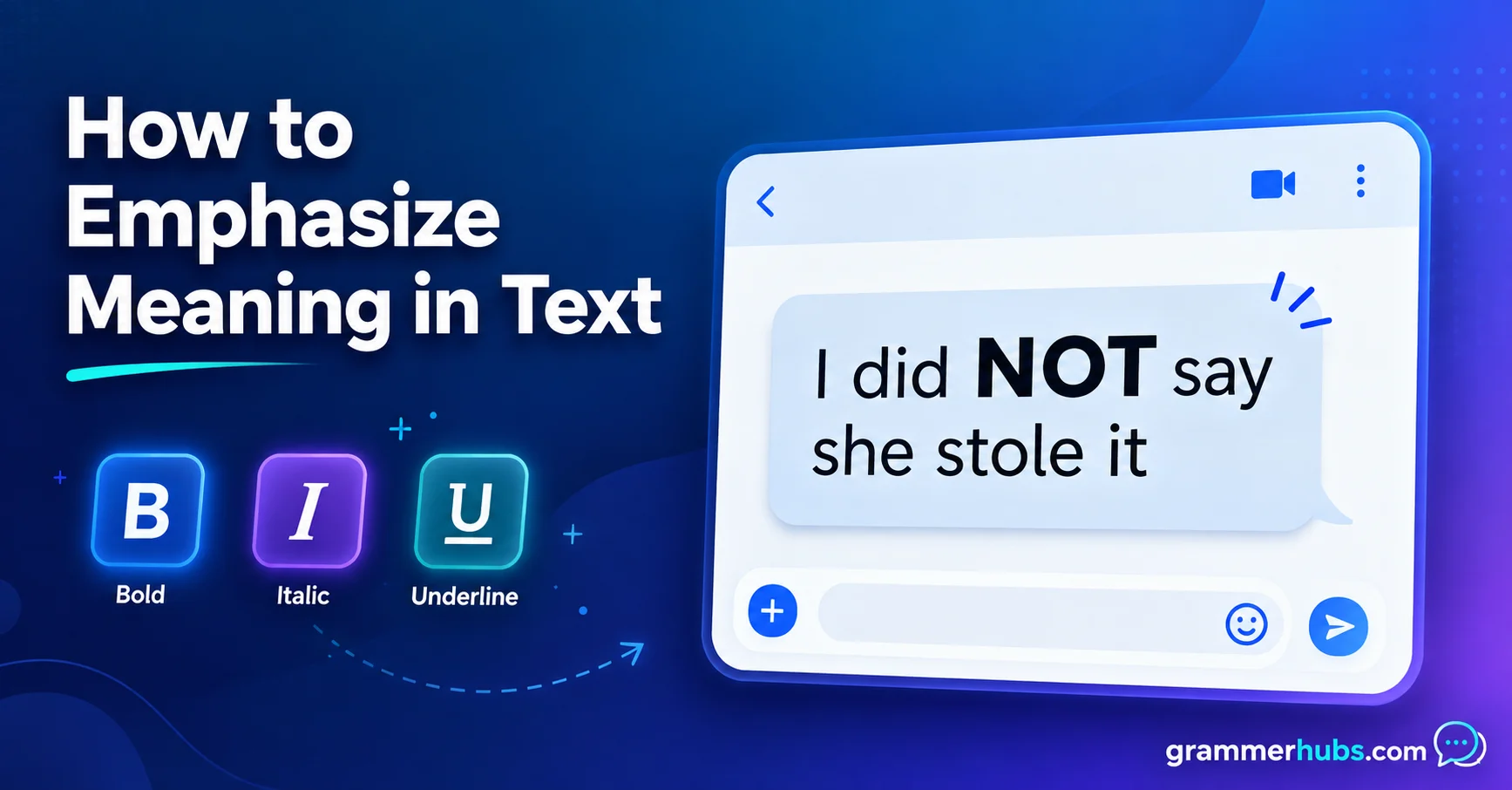
You emphasize meaning in text by using bold, italics, punctuation, word order, capitalization, or emojis to show a reader which word or idea matters most the same job your voice does when you stress a word out loud.
Ever sent a text and had someone read it the wrong way? You meant it as a joke. They read it as an attack. That’s the core problem with written communication: there’s no tone of voice, no raised eyebrow, no pause before the punchline. So writers, texters, and content creators lean on formatting and word choice to do that job instead.
This matters everywhere: in a text message to a friend, a caption on social media, a callout in a gaming chat, or a formal email to your boss. Get it right, and your message lands exactly how you meant it. Get it wrong, and you’re stuck typing sorry, I meant that as a joke 😅 for the third time this week.
Let’s break down exactly how emphasis works in text and how to use it well.
What Does Emphasize Meaning in Text Actually Mean?
At its core, emphasis is the act of drawing attention to a specific word, phrase, or idea so the reader understands what matters most. In spoken language, we do this naturally through stress, pitch, pauses, and volume. In written language, we need visual or structural substitutes.
There are two related ideas hiding inside this keyword, and both are useful:
- Emphasizing a word using bold, italics, or capitals to highlight it.
- Emphasizing the meaning makes sure the reader understands your actual intent, not just your words.
Example:
- Plain: I did not say she stole the money.
- Emphasized: I did not say she stole the money.
Notice how shifting the bold word completely changes what the sentence implies. That’s semantic emphasis in action: the words stay the same, but the meaning shifts based on what’s highlighted.
Common tools for this include:
- Bold text for importance or urgency
- Italics for tone, sarcasm, or foreign/technical terms
- CAPITAL LETTERS for shouting or strong emotion (use sparingly)
- Punctuation (like the ellipsis or an exclamation point!) for pacing and feeling
- Emojis 😉 for tone-softening or humor cues
A Short History of Emphasis in Writing
Long before bold buttons existed, writers had to get creative. Ancient manuscripts used larger lettering or colored ink (like illuminated red text, called rubrication) to mark important passages. Printers later introduced italics in the 15th century originally just a compact font style, but it quickly became a tool for signaling emphasis and titles.
Typewriters brought a new trick: since there was no bold key, writers underlined words or used ALL CAPS to stand out. That habit stuck around and evolved.
Then came the internet. Early forums and instant messengers couldn’t render bold or italics at all, so users invented their own markup:
- asterisks for bold
- underscores for italics
- ALL CAPS for shouting
This is actually the ancestor of Markdown syntax, which now powers formatting across Google Docs, Microsoft Word, Slack, Reddit, and countless writing apps. What started as a workaround became a standard.
Emphasis in Everyday Communication
In texting:
Friend: Are you mad at me?
You: No, I’m not mad. I’m just tired.
The bold word tells your friend exactly what to focus on the negation, not the tiredness.
In social media captions:
Creators often emphasize a hook word to boost readability and scroll-stopping power:
This one habit changed everything.
In gaming chat:
Watch the left flank, not the right!
One bolded word can be the difference between a team winning a round or getting caught off guard.
In professional emails:
Please submit the report by Friday, not next week.
Here emphasis isn’t about emotion it’s about clarity and reducing back-and-forth confusion.
Common Misconceptions About Emphasis
Misconception 1: More emphasis = more important.
Overusing bold or caps dilutes the effect. If everything is bold, nothing stands out. Emphasis works best when it’s rare and intentional.
Misconception 2: ALL CAPS always means yelling.
Mostly true online but in some contexts (headlines, acronyms, gaming usernames) it’s just style, not shouting.
Misconception 3: Emphasis is only about formatting.
Not quite. You can emphasize meaning through word order, sentence length, and repetition too no bold or italics required.
I told you. I told you twice. And you still didn’t listen.
That’s emphasis through rhythm, not formatting.
Similar Terms and Related Concepts
| Term | What It Means | Example |
| Stress (linguistics) | Vocal emphasis on a syllable/word | I love this vs I love this |
| Highlighting | Visually marking text, often with color | Yellow-highlighted key terms in notes |
| Bolding | Thickening font weight for emphasis | Important |
| Italicizing | Slanting text for tone or titles | The Great Gatsby |
| Underlining | Drawing a line under text for emphasis | Underlined links or titles |
| Semantic weight | The importance a word carries in meaning | Choosing urgent over soon |
These aren’t interchangeable; each carries a slightly different connotation, so picking the right one changes how your message is received.
How to Emphasize Meaning the Right Way (By Context)
Casual texting:
lol I’m not mad, I’m just tired tired 😂
Professional writing:
Please review the attached document; the deadline has moved up to Thursday.
Creative or storytelling content:
She didn’t just leave. She ran.
Privacy-conscious or formal settings:
Avoid caps-lock or heavy emojis. Stick to bold for key terms only, and let sentence structure carry the rest of the emphasis.
Do Other Languages and Cultures Emphasize Text Differently?
Yes. In Japanese, emphasis dots (◦) are sometimes placed above characters to stress a word a technique with no English equivalent. In Arabic and other right-to-left scripts, italics don’t render the same way, so writers often use bold or repetition instead. In many East Asian messaging apps, emojis and stickers carry more emphasis weight than text formatting does.
Even within English-speaking cultures, norms shift: British professional writing tends to underuse bold and exclamation points compared to American marketing copy, which leans heavily on bold, caps, and emojis for punch.
Emphasis vs. Overemphasis: Where’s the Line?
| Style | Comes Across As | Best Used In |
| One bolded word per message | Clear, intentional | Texts, emails, captions |
| Multiple bold words per sentence | Cluttered, hard to read | Rarely appropriate |
| ALL CAPS full sentence | Shouting, aggressive | Avoid in most contexts |
| Italics for a single phrase | Subtle tone shift | Sarcasm, titles, quotes |
| Repeated punctuation (!!!) | High excitement or urgency | Casual chat, not formal writing |
The goal is always readability; emphasis should guide the reader, not overwhelm them.
Emphasis in Digital Platforms and Online Writing
On social media, the first few words of a post often carry the heaviest emphasis because they determine if someone keeps scrolling or stops. On messaging apps, a single bolded or capitalized word often replaces an entire sentence of explanation. In online communities and forums, formatting conventions (like Markdown asterisks) are so common that most platforms auto-render them, meaning users now write with emphasis in mind from the very first draft.
Are There Hidden or Negative Interpretations?
Emphasis can backfire. ALL CAPS in a text often reads as anger, even when the sender meant enthusiasm. Overusing bold in a professional email can feel condescending, as if you’re assuming the reader needs everything spelled out. Sarcastic italics (sure, that’s fine) can come across as passive-aggressive if the relationship or context doesn’t support it.
Tone and context always outrank formatting. The same bolded word can read as helpful in one relationship and rude in another. It depends on who’s reading it and what came before.
Is Emphasis Appropriate in Professional Communication?
Yes with restraint. Professional writing benefits from:
- Bold for deadlines, action items, or key terms
- Clear sentence structure instead of exclamation points
- Avoiding ALL CAPS entirely
- Using italics sparingly, mainly for titles or specific terms
Instead of This is SUPER important!!!, a professional alternative is: This is a priority please confirm receipt by end of day.
FAQs
1. What’s the easiest way to emphasize meaning in a text message?
Use bold or asterisks around the one word that matters most and don’t emphasize the whole sentence.
2. Is using all caps considered rude?
In most digital contexts, yes it usually reads as shouting, even if that’s not the intent.
3. Can punctuation alone create emphasis?
Yes. An ellipsis can suggest hesitation, while a single exclamation point can suggest excitement without needing bold or caps.
4. Why does emphasis matter for SEO and readability?
Bolded key points and clear structure help both readers and search algorithms quickly identify the main ideas, improving comprehension and ranking potential.
5. What’s the difference between emphasis and emotion in text?
Emphasis highlights which word matters; emotion conveys how you feel about it; they often work together but aren’t the same thing.
6. Should I use emojis to emphasize meaning?
In casual contexts, yes they add tone. In professional writing, they’re best avoided or used very sparingly.
7. How much emphasis is too much?
If more than one word per sentence is bolded or capitalized, it’s likely too much emphasis loses power when overused.
Conclusion
Emphasizing meaning in text isn’t about decoration, it’s about clarity.
If you’re texting a friend, posting on social media, chatting in a game, or writing a professional email, the right emphasis (bold, italics, punctuation, or word choice) makes sure your reader understands exactly what you meant, not just what you typed.
Use it sparingly, match it to the context, and remember: the best emphasis is the kind your reader doesn’t even notice they just get.
Discover More Posts!
- In-Text Citation? Meaning, Examples & Easy Formatting Tips
- Exclamation Mark Mean in Text? Decode the Real Tone

I’m Chloe Mitchell, a passionate writer at Grammerhubs.com specializing in English grammar, word meanings, slang terms, and modern language trends. I create clear, engaging, and easy-to-understand content that helps readers master everyday English with confidence.







3 thoughts on “How to Emphasize Meaning in Text: Bold, Italics & Tone Tricks”