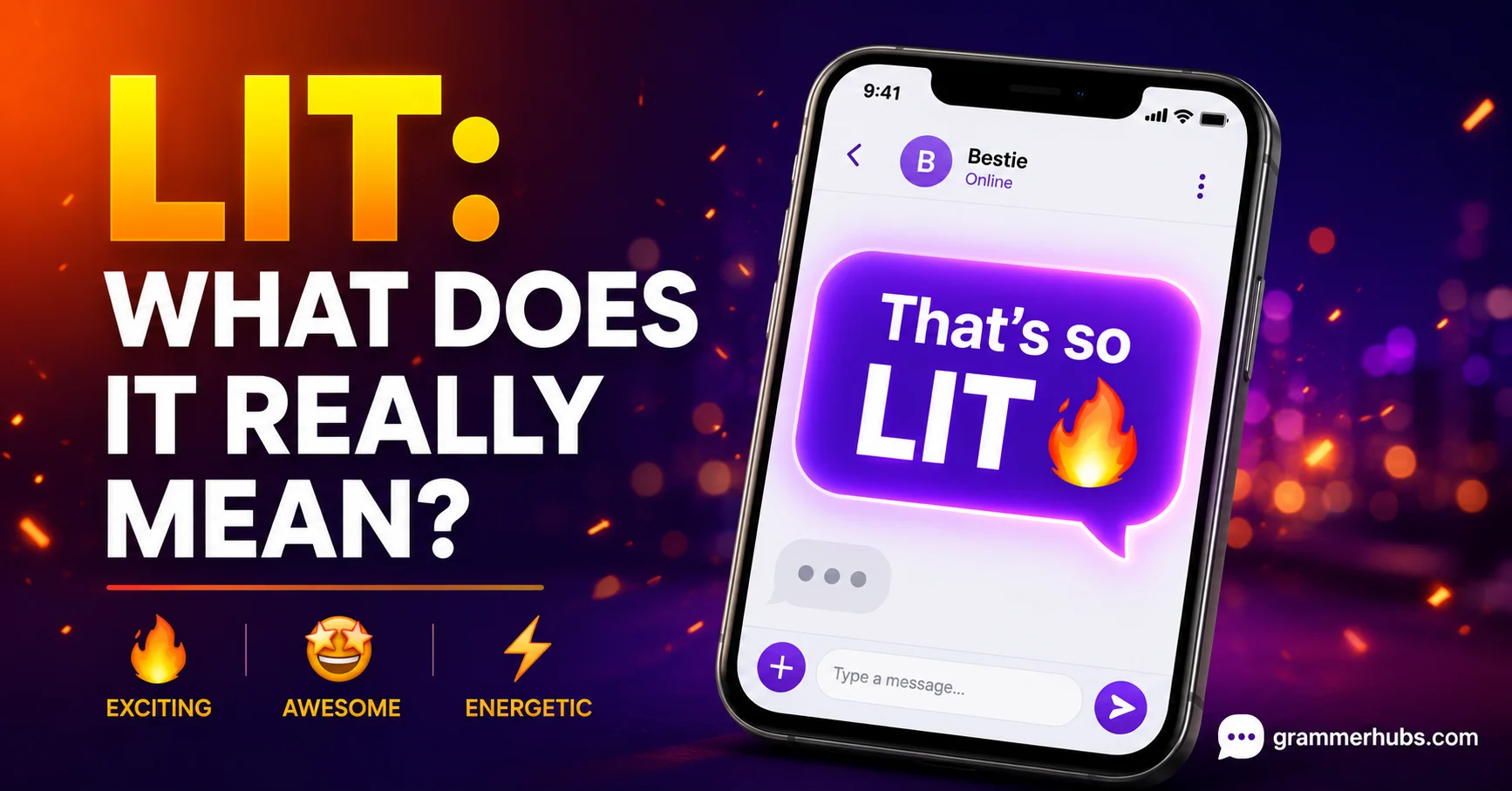
If someone texts you that something is Lit, they mean it’s exciting, amazing, or just really good. A Lit party, a Lit song, a Lit night out all of it means the same basic thing: energy, in a good way.
That’s the answer most people are looking for. But Lit has a longer, more interesting story than most slang explainers give it credit for, and knowing that story actually helps you use the word better and know when not to use it.
You’ll run into Lit constantly: in texts, in Instagram captions, in Discord servers, in group chats after a night out. It’s casual, it’s fast to type, and it’s stuck around far longer than most slang manages to. That staying power is part of why it’s worth understanding properly, instead of just guessing from context every time it shows up.
So What Does Lit Actually Mean?
Lit is a slang adjective. It’s not an acronym, even though people sometimes assume it stands for something it doesn’t. It’s simply the word Lit (the past tense of light) used figuratively.
The meaning people use most today: exciting, amazing, or excellent.
Friend: How was the concert? You: Honestly so Lit. My ears are still ringing.
Group chat: Bro that game last night was Lit, did you see the last two minutes?
Instagram caption: Lit night with the best people 🔥
The older meaning, which still exists: drunk or intoxicated.
According to Merriam-Webster, this sense of Lit isn’t new slang at all; it’s over a century old, showing up in print as early as 1918. It’s tied directly to the Literal meaning of Lit, as in something illuminated or glowing. Somewhere along the way, Lit up came to describe someone who’d had a lot to drink, and the shorter Lit followed.
The exciting meaning is the newer development. Merriam-Webster traces the shift to hip-hop culture in the 2010s, when Lit moved from describing a person’s state (I’m about to get Lit) to describing an atmosphere (this party is Lit). Once Lit started describing a vibe instead of a person’s blood alcohol content, it opened the door to describing basically anything with energy, songs, games, group chats, even people’s personalities.
There’s also a third, unrelated Lit: short for Literature, used almost exclusively in school contexts (Lit class, Lit review). Nobody confuses this with the slang meaning in practice the context does all the work.
Where Lit Actually Comes From
This part matters, and it’s the part a lot of slang explainers skip.
Lit, like a large share of the slang that circulates through texting and social media bussin, cap, slaps, finna has its roots in African American Vernacular English (AAVE). AAVE is a fully developed dialect with its own grammar and history, not just a collection of trendy words, and a lot of what people casually call internet slang or Gen Z slang is really AAVE that’s crossed over into mainstream use through music, especially hip-hop, and later through social media.
That crossover is exactly how Lit spread. The intoxicated meaning existed for decades in relatively narrow circles. It was hip-hop culture in the 2010s that pushed the newer exciting meaning into the mainstream, and platforms like Vine, Twitter, and later TikTok did the rest, turning it into one of the default words people reach for when they want to say something was good without sounding boring.
By the late 2010s, Lit was fully mainstream. It had made its way into Merriam-Webster’s slang coverage, into countless memes, and into everyday texting across pretty much every English-speaking demographic, not just the communities and cultures it came from.
Worth knowing: because of that history, some people consider it a little tone-deaf when non-Black speakers use AAVE-derived slang without any awareness of where it comes from. Using Lit casually isn’t considered offensive by most people at this point; it’s about as mainstream as slang gets but knowing its roots is part of using it thoughtfully rather than treating it like disposable internet jargon.
How People Actually Use It
Texting between friends:
Are you coming tonight? Yeah, it’s gonna be Lit.
On social media, it’s often paired with fire emojis (🔥), which reinforce the same hot/exciting idea visually. You’ll see it in captions, comments, and reaction posts.
In gaming chats and Discord servers, it usually reacts to something impressive in real time:
That clutch was Lit New update is Lit ngl, they actually added stuff people asked for
In everyday conversation, it stretches to cover almost anything with good energy, food, music, a person’s mood, a random Tuesday that turned out better than expected.
This burger is Lit. She’s always got Lit energy, love hanging out with her.
The common thread across all of these: positive, high-energy, and casual. It’s rarely sarcastic, though sarcasm is possible with the right tone (oh yeah, real Lit said flatly usually means the opposite).
Where People Get It Wrong
A few mix-ups come up constantly:
It’s an acronym. It isn’t. It’s just the word Lit, used figuratively.
It always means drunk. Not anymore, really. The exciting meaning is now dominant in texting and social media. Context tells you which one means the party was Lit is describing the vibe, not confirming everyone’s sobriety.
It’s brand new slang. Not even close. The intoxicated meaning is over 100 years old, and the exciting meaning has been mainstream since the mid-2010s. If anything, it’s one of the more established pieces of internet slang still in regular use.
It’s offensive to use. Generally, no it’s about as normalized as slang gets. But it’s still worth knowing where it came from (see above), especially if you’re using AAVE-derived words a lot without ever having thought about their origin.
Words People Use Instead
Lit isn’t alone. It sits in a small family of words that all point toward the same general idea: something is good, exciting, or high-energy but each has its own flavor.
| Term | What it means | Typical use |
| Fire 🔥 | Excellent, impressive | Music, food, outfits |
| Bussin | Really good, usually food | This is bussin |
| Turnt | Hyped, high party energy | Nightlife, parties |
| Goated | The best, greatest ever | Skills, performances |
| No cap | Not exaggerating, for real | Paired with other slang for emphasis |
| Slaps | A song that’s really good | Music specifically |
The difference is worth noting: Lit usually describes a moment or atmosphere (the party was Lit), while words like bussin or slaps usually describe one specific thing (food, a song). They overlap constantly in real conversation, though it’s common to see two or three of these stacked in a single text.
How to Respond When Someone Texts You Lit
There’s no single right answer, it depends on who’s texting you.
With a close friend, casual and enthusiastic works fine:
Lit!! Wish I’d been there 🔥
If you want to play it for a laugh:
Lit as in fun, or Lit as in someone actually set something on fire?
In a work chat, where slang feels a Little out of place:
Sounds like it was a great event!
If you’re just not that into slang, or don’t know the person well:
Glad you had a good time!
The main thing is matching energy. Mirroring slang with close friends feels natural; doing it with a boss or a stranger can come across as trying too hard.
Does It Mean the Same Thing Everywhere?
Mostly, yes Lit has traveled far enough through music and social media that it’s understood across the US, UK, Canada, and Australia, and increasingly among younger, internet-connected speakers well beyond English-speaking countries.
That said, regional favorites still exist alongside it:
- In the UK, sick and peak cover similar territory (though peak can actually mean bad, confusingly, depending on who’s saying it).
- In Australia, being mad and sick are common alternatives.
- In parts of the Caribbean, vibes or local phrasing often does the same job.
None of these have replaced Lit they just coexist with it, and which one someone reaches for often comes down to where they’re from more than what they mean.
On Dating Apps and Online Communities
On Twitter/X, Lit shows up reacting to trending moments. This whole timeline is Lit today more than describing personal events.
In gaming communities, it’s a quick way to hype an update, a play, or a stream moment in real time.
On apps like Tinder or Hinge, it usually shows up describing lifestyle or personaLity:
Match: What are your weekends usually like? You: Pretty chill honestly, occasional Lit night out but mostly low-key.
If a match uses Lit, there’s rarely anything to overanalyze mirroring the casual tone back tends to work better than reading into it.
Is There a Hidden or Negative Meaning?
For the most part, no Lit is about as mainstream and low-stakes as slang gets. A couple of things are still worth flagging:
- The older drunk/high meaning can still surface, especially in sentences like he was way too Lit last night, so context matters.
- As covered above, it comes from AAVE, and some people consider it worth using with a bit of awareness rather than as generic internet talk with no history attached.
- Tone can flip it: said flatly or sarcastically, yeah, real Lit usually means the opposite boring, or a letdown.
None of this makes the word risky to use. It just means, like most slang, the people involved and the tone matter more than the word on its own.
Is It Okay to Use at Work?
Generally, no save it for texts and casual chat, not client emails or formal reports. Even in workplaces with a relaxed culture, it’s a judgment call, and it’s easy to swap in something more neutral without losing the enthusiasm:
- That was a great event.
- The team’s energy was excellent.
- It was a genuinely engaging session.
Common Questions
What does Lit mean in a text from a girl or guy?
Almost always the same thing regardless of who’s sending it exciting, fun, or impressive. It’s not typically flirtatious or loaded with hidden meaning.
Is Lit still used in 2026?
Yes. Newer slang keeps showing up alongside it, but Lit has held on longer than most trend words usually do.
What does Lit af mean?
Af is short for as f***, used as an intensifier. Lit af just means extremely exciting or impressive.
Can Lit be sarcastic?
Yes, tone does the work. Said dryly, it can mean the opposite of exciting.
Is it okay to text Lit to parents or teachers?
It won’t offend anyone, but it can read as trying a bit too hard outside close, casual relationships.
Does Lit mean the same thing on every app or platform?
Pretty much. The core meaning of exciting, high energy holds steady across texting, social media, and gaming spaces.
The Bottom Line
Lit means exciting, amazing, or full of good energy. That’s the meaning you’ll run into nearly every time it shows up in a text or on social media.
It carries an older meaning too (intoxicated), and it comes from African American Vernacular English, a detail that’s easy to miss but worth knowing if you use AAVE-derived slang regularly.
Once you know both the current meaning and where it came from, Lit stops being a word you’re guessing at and becomes one you can use or reply to without a second thought.
Read More Posts!
What Does OLS Mean in Text? The Real Answer
What Does SMO Mean? Decoded For Snapchat, Texts & More
What Is Tuff Slang? Surprising Origin & Real Meaning
DWL Meaning in Text: Funny Slang Explained

I’m Emma Reynolds, and I live and breathe everyday slang at GrammerHubs.com. I love breaking down the weird, short ways we text each other. No boring grammar lessons here, just real talk about how we actually chat.



2 thoughts on “Lit Mean in Text? Real Answer & Its Surprising Origin”