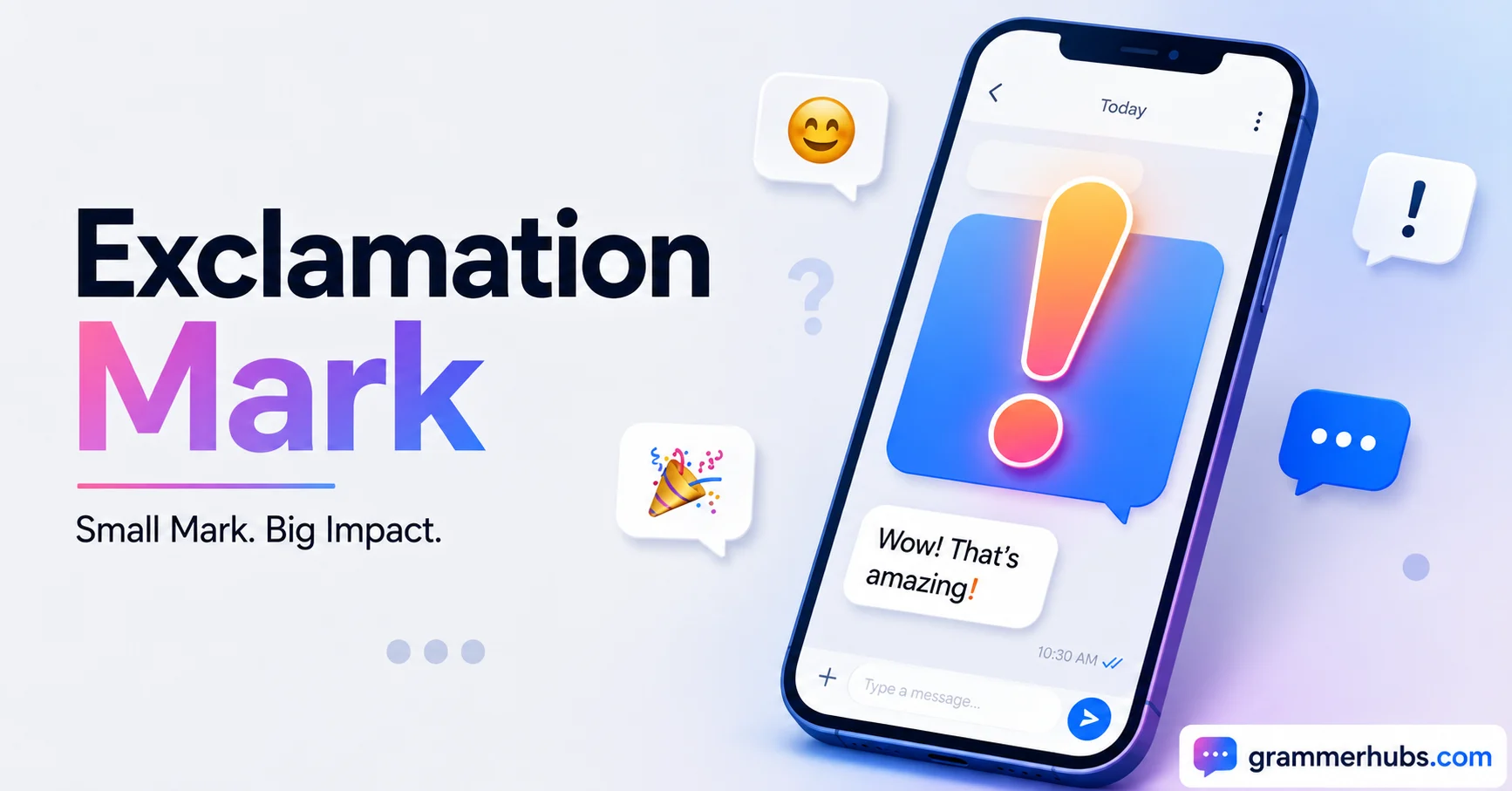
An exclamation mark (!) in text usually signals excitement, emphasis, or genuine enthusiasm but depending on tone, punctuation etiquette, and who’s texting, it can also read as friendly warmth, urgency, sarcasm, or even passive-aggressiveness. Context is everything.
You just got a text back. It says: Sounds good! Instead of just Sounds good. Why does one tiny punctuation mark make you pause and wonder what they really meant?
That’s the strange power of the exclamation point. In texting, social media, gaming chats, and even professional emails, this single character carries an outsized emotional load. It can turn a flat sentence into something warm, urgent, or hyped or, if overused, make you sound unhinged. Understanding what an exclamation mark means in text isn’t just a grammar question anymore. It’s basic digital communication literacy, and getting it wrong can genuinely change how a conversation feels.
This guide breaks down the real meaning behind the exclamation mark where it comes from, how it’s used across platforms, what it signals in dating apps and DMs, and how to respond to it without overthinking (too much).
Definition & Meaning of the Exclamation Mark
At its core, an exclamation mark (also called an exclamation point) is a punctuation mark used to express strong emotion excitement, surprise, urgency, or emphasis. In formal writing, it’s reserved for genuine exclamations: Watch out! or That’s incredible!
But in text messaging and casual digital communication, its job has expanded. It’s no longer just about shouting. It’s about tone. A period at the end of a text can read as cold or annoyed. An exclamation mark softens it, adding friendliness and energy that would otherwise be missing from plain text.
Real-life examples show the shift clearly:
- Okay. feels blunt, maybe irritated.
- Okay! feels upbeat, agreeable, warm.
- Okay!! feels enthusiastic, maybe overly eager.
- OKAY!!! feels like shouting, sarcasm, or barely-contained excitement (context-dependent).
This is the essence of what an exclamation mark means in text: it’s a tone marker first, and a grammar tool second. It fills in for the facial expressions, vocal inflection, and body language that get lost when communication moves from face-to-face to a screen.
Background & History of the Exclamation Mark
The exclamation mark has a surprisingly old and slightly mysterious origin. Some etymologists trace it back to medieval Latin scribes who wrote Io (an interjection of joy) at the end of sentences, eventually stacking the I over the o until it evolved into the mark we recognize today. It appeared in English printing by the 15th century, originally called the note of admiration.
For centuries, its use was rare and reserved a mark for genuine shock, joy, or alarm in literature and formal writing. Style guides traditionally warned writers to use it sparingly, famously summarized by writer Elmore Leonard’s rule of using no more than a few per hundred thousand words.
Then texting happened.
As SMS, instant messaging, and later social media exploded, the exclamation mark got repurposed. Without tone of voice, writers needed a way to signal friendliness quickly. The exclamation mark became the default fix for sounding nice in short, fast digital exchanges. Linguists have studied this shift extensively. It’s become less about genuine exclamation and more about social lubrication in informal writing.
Today, its meaning is almost entirely context-driven. On WhatsApp, iMessage, Slack, or Discord, one exclamation point is often just baseline politeness not real excitement at all. That’s a major shift from its formal, dramatic origins.
Usage in Various Contexts
The meaning of ! changes significantly depending on where and how it’s used.
In texting (SMS/iMessage):
Sam: Dinner at 7? Jordan: Yes!! Can’t wait
Here, the double exclamation signals genuine excitement, not just politeness.
In professional email:
Thanks for sending this over! Let me review and get back to you by Friday.
One exclamation mark keeps things warm without sounding unprofessional, a common move in modern email communication.
On social media:
I just landed my dream job!!! 🎉
Multiple exclamation marks paired with emoji amplify genuine celebration very normal on Instagram, Twitter/X, and Facebook.
In gaming communities (Discord/Twitch chat):
gg that was confusing!!
Here it signals hype and shared adrenaline, common shorthand in fast-paced gaming chat culture.
In casual conversation between friends:
A: I’m outside B: omw!
A single ! simply softens the message friendly, not necessarily thrilled.
Across all these contexts, the exclamation mark functions as an emotional amplifier. The number of marks, the platform, and the relationship between the two people all shape the real meaning.
Common Misconceptions & Clarifications
A lot of confusion especially in dating and casual texting comes from misreading punctuation etiquette.
Misconception 1: No exclamation mark = they’re mad. Not always true. Some people simply write in a flat, minimal style regardless of mood. This is a generational and personal-style difference, not a guaranteed emotional signal.
Misconception 2: More exclamation marks = more genuine excitement. Sometimes true, but excessive exclamation points (!!!!!) can also signal sarcasm, forced enthusiasm, or passive-aggressiveness. Think of a coworker replying Sure!!! to a last-minute deadline.
Misconception 3: A single ! always means happiness. In professional or older-generation texting norms, a single exclamation point often just means neutral politeness, not strong emotion at all.
Misconception 4: It’s inappropriate in formal writing. Not entirely true used sparingly, a single exclamation mark in a professional email can convey warmth without being unprofessional. The issue is overuse, not existence.
The bottom line: tone in text is never guaranteed by punctuation alone. Relationship history, typical texting style, and surrounding words all matter more than the exclamation mark by itself.
Similar Terms & Alternatives
Several other punctuation and text-based tools serve similar tone-softening or emphasis purposes.
| Term/Symbol | Common Meaning | Typical Use Case |
| Period (.) | Neutral, sometimes cold or serious | Formal texts, or signaling annoyance |
| Question mark (?) | Curiosity, confusion, or genuine question | Clarifying requests |
| Ellipsis (…) | Hesitation, trailing thought, awkward pause | Uncertain or suspenseful replies |
| ALL CAPS | Shouting, strong emphasis, excitement or anger | Emphasis, hype, sometimes anger |
| Emoji (🎉😂❤️) | Visual emotional cue | Adds explicit tone/context |
| Multiple exclamation marks (!!!) | Heightened excitement or urgency | Big news, celebration, hype |
Understanding these related expressions helps clarify why the exclamation mark stands out it’s uniquely flexible, working as both an emphasis tool and an emotional softener.
How to Respond to This Term (or Message Using It)
How you respond to a text with an exclamation mark depends on the vibe you want to match or set.
Casual response:
Them: We’re getting pizza tonight! You: Yesss finally!
Funny response:
Them: I got the promotion!!! You: STOP. Buying you a cake immediately
Professional response:
Them: Great meeting today! You: Agreed looking forward to next steps.
Privacy-conscious / neutral response:
Them: Miss you!! You: Same, let’s catch up soon.
A good rule: match the energy level roughly, unless you intentionally want to dial the tone up or down. Mirroring punctuation style is a subtle but effective way to build rapport in digital conversation.
Regional or Cultural Differences
Exclamation mark usage isn’t universal. In many East Asian texting cultures (like Japan and Korea), emoticons, kaomoji, and stickers often carry more emotional weight than punctuation itself, with exclamation marks used more sparingly in formal contexts.
In the U.S. and much of Western social media culture, exclamation marks are used liberally, especially among younger users, where a single ! is often considered the bare minimum for sounding friendly rather than curt.
In British texting norms, there’s traditionally been more restraint alone period is less automatically read as rude compared to American texting culture, though this is shifting with global social media influence.
In professional French or German business communication, exclamation marks are typically used more conservatively than in casual American texting, reflecting differing formality norms.
These cultural nuances matter especially in international teams or cross-cultural dating apps, where the same punctuation can be read very differently.
Comparison With Similar Expressions
| Expression | Emotional Intensity | Best Context |
| Okay. | Low / possibly cold | Formal, or signaling displeasure |
| Okay! | Moderate / friendly | Everyday casual texting |
| Okay!! | High / enthusiastic | Excited agreement |
| Okay… | Uncertain / hesitant | Reluctant agreement |
| OKAY (caps, no punctuation) | Emphatic, sometimes annoyed | Frustration or strong emphasis |
This table highlights how small punctuation shifts create entirely different user intent signals, a key reason misreadings happen so often in text-based communication.
Usage in Online Communities & Dating Apps
On dating apps like Tinder, Hinge, and Bumble, exclamation marks are almost a soft social requirement. A flat Hey can come across as low-effort or disinterested, while Hey!! How’s your week going? signals approachability and warmth.
On Twitter/X, exclamation marks often appear in hype tweets, announcements, or reactions to trending topics helping posts feel more energetic and shareable.
In gaming communities (Discord, Twitch chat, Xbox/PlayStation messaging), exclamation marks reinforce excitement during high-stakes moments clutch plays, wins, or funny fails.
Tip for responding appropriately: On dating apps, match their punctuation energy in your first few replies. If they’re using multiple exclamation marks, mirroring that enthusiasm (without overdoing it) tends to build better rapport than replying with flat, punctuation-free texts.
Hidden or Offensive Meanings
Does the exclamation mark have a dark side? Occasionally, yes though it’s rarely offensive on its own.
Sarcasm risk: Wow, great job!!! can easily read as sarcastic or condescending depending on context, especially in workplace messaging after a mistake.
Passive-aggressiveness: An overly cheerful Just following up on this!! after no response can carry a subtle edge of impatience or irritation, despite the friendly punctuation.
Forced enthusiasm: In professional settings, excessive exclamation marks can sometimes be read as insincere or trying too hard, undermining credibility.
The key takeaway: exclamation marks amplify whatever emotional undertone already exists in a message. They rarely create offense on their own but they can intensify sarcasm, urgency, or irritation that’s already present in the wording.
Suitability for Professional Communication
Is the exclamation mark appropriate in professional writing? Yes, in moderation.
A single exclamation mark in a work email (Thanks so much!) is now widely accepted as normal, even expected, in most modern workplace communication it signals warmth without sacrificing professionalism.
However, multiple exclamation marks, exclamation marks in serious or bad-news emails, or overuse across every sentence can undermine authority and come across as unprofessional or overly casual.
Professional alternatives:
- Use Thank you or Thanks so much without punctuation emphasis for very formal contexts.
- Reserve ! for genuine positive news, appreciation, or enthusiasm not routine statements.
- When in doubt, default to a period; you can always adjust tone with word choice instead.
FAQs
1. What does one exclamation mark mean in a text?
Usually mild enthusiasm, friendliness, or simple politeness are not necessarily strong emotions.
2. Is it rude to text without any exclamation marks?
Not inherently, though depending on the person’s usual style, it can sometimes read as flat, serious, or slightly cold.
3. What does !!! mean from a guy or girl while texting?
Typically genuine excitement or strong interest is often a positive sign in casual or dating contexts, though tone and prior conversation history matter.
4. Is using exclamation marks in emails unprofessional?
No one used sparingly is considered normal and even friendly in most modern workplaces. Overuse is the actual issue.
5. Why do exclamation marks feel necessary in texting now?
Because text lacks tone of voice and facial expression, exclamation marks help convey warmth and friendliness that would otherwise be missing.
6. Can an exclamation mark be sarcastic?
Yes, paired with certain phrases (Great, thanks!!!) it can signal sarcasm or frustration rather than genuine positivity.
7. Do other cultures use exclamation marks the same way?
No usage varies significantly, with some cultures relying more on emoji or stickers, and others using punctuation more conservatively in formal contexts.
Conclusion
The exclamation mark has quietly evolved from a rare literary device into one of the most important tone signals in modern digital communication.
If you’re texting a friend, replying on a dating app, posting on social media, or emailing a coworker, this small mark shapes how warm, excited, sarcastic, or professional your message feels.
Understanding what an exclamation mark means in text and reading it in context rather than isolation helps avoid misunderstandings and makes your own messages land the way you actually intend.
Read More Posts!
What Does NM Mean In Text? Real Answer + Examples
How to Emphasize Meaning in Text: Bold, Italics & Tone Tricks
In-Text Citation? Meaning, Examples & Easy Formatting Tips

I’m Chloe Mitchell, a passionate writer at Grammerhubs.com specializing in English grammar, word meanings, slang terms, and modern language trends. I create clear, engaging, and easy-to-understand content that helps readers master everyday English with confidence.









1 thought on “Exclamation Mark Mean in Text? Decode the Real Tone”