Introduction
Someone told you to “send a GIF” and you nodded like you knew exactly what that meant. No judgment. We have all been there. GIF stands for “Graphics Interchange Format,” and in text messages it means those short, looping animations that say what words cannot.
You know the ones. A cat typing furiously. Michael Scott yelling “No!” A celebrity eye-roll on endless repeat. GIFs are the body language of texting, and they are everywhere. But what exactly is a GIF, where did it come from, and how do you use one without looking like a confused time traveler? Let us get into it.
Definition and Meaning
GIF stands for Graphics Interchange Format. It is an image file format invented way back in 1987. But when someone says “send me a GIF” in a text, they are not talking about file formats. They mean a short, silent, looping animation, usually a few seconds long, that expresses a reaction or a joke.
Think of a GIF as a mini video clip stuck on repeat. No sound, no play button, no timeline. It just loops forever, delivering the same three seconds of emotion over and over.
Here is how GIFs show up in real chats:
- Friend: “I just got the job!” You: [GIF of someone dancing wildly] (Translation: I am thrilled and words are not enough.)
- Friend: “He texted ‘k.'” You: [GIF of an eye-roll] (Translation: the audacity.)
- Group chat at midnight: [GIF of a raccoon eating pizza] (Translation: no words, just vibes.)
- Mom learns to send GIFs: [GIF of fireworks] for every occasion, including Tuesdays.
A GIF can say “congratulations,” “I am laughing,” “this is awkward,” or “I have no words” better than any sentence. That is the whole point. Texting strips away tone of voice and facial expressions. GIFs put some of that back.
Technically, a GIF file is just a series of still images played in sequence, like a flipbook. The format supports up to 256 colors per frame, which is why GIFs can look a little grainy or retro compared to modern video. That lo-fi look is part of the charm.
One quick note on pronunciation, because this debate has ended friendships: the creator of the format, Steve Wilhite, said it is pronounced “jif,” like the peanut butter. Half the internet disagrees and says “gif” with a hard G. Both are widely used. Say it however you want, but know that someone, somewhere, will correct you.
Background and History
The GIF is older than the World Wide Web itself. Let that sink in.
In 1987, a team at CompuServe led by Steve Wilhite created the Graphics Interchange Format to solve a simple problem: images took forever to download on dial-up connections, and different computers displayed colors differently. GIF compressed images and standardized colors so a picture looked the same everywhere. It was a workhorse format for the early internet: logos, icons, buttons, and those gloriously tacky “under construction” banners.
For years, GIFs were just… images. Some were animated, mostly used for cheesy banner ads and dancing baby memes. Then the format nearly died. In the mid-2000s, faster formats like PNG and Flash took over, and the GIF looked like a relic.
But the GIF refused to die, because it had one killer feature: it animated without needing a video player or a plugin. As social media and smartphones exploded in the early 2010s, the animated GIF found its true calling as a reaction language.
Tumblr was the GIF’s first great renaissance home. Users posted endless loops of TV shows, movies, and music videos. Reaction GIF culture was born there: instead of typing “that is funny,” you posted a GIF of someone laughing.
Then came the infrastructure. Giphy launched in 2013 as a GIF search engine, and Tenor followed. Messaging apps built GIF search right into the keyboard. Suddenly, finding the perfect reaction GIF took three seconds. iMessage, WhatsApp, Messenger, and later Instagram DMs all added one-tap GIF buttons.
Today, billions of GIFs are sent every day. The format that started as a CompuServe compression trick became the emotional vocabulary of the internet. Not bad for 256 colors.
Usage in Various Contexts
GIFs are versatile. Here is where they shine and how people actually use them.
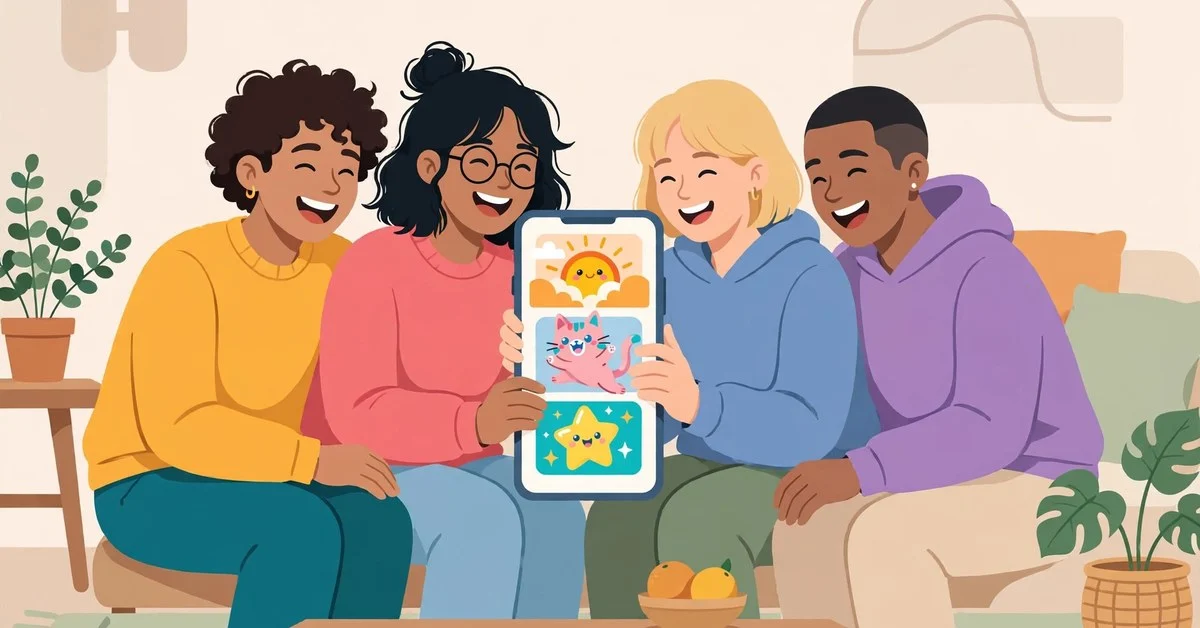
Texting with friends: The classic use. Reactions, jokes, and emotional shorthand.
- Friend: “Exam got postponed!”
- You: [GIF of happy dance]
Group chats: GIFs are group chat fuel. One good reaction GIF can derail a whole conversation in the best way.
- Someone shares gossip: [GIF of popcorn eating]
- Someone makes a bad pun: [GIF of slow clap]
Social media comments: On TikTok, Instagram, and X, GIF replies are a whole love language. A well-timed GIF comment often gets more likes than the post itself.
Dating apps: A funny GIF can break the ice better than “hey.” It shows personality without the pressure of a clever opener.
- [GIF of a waving penguin] with “this is me saying hi”
Work chats: In relaxed teams, GIFs add warmth to Slack and Teams. A thumbs-up GIF beats a plain “ok” for friendliness. But read the room. More on this in the professional section.
Family chats: Parents and grandparents discovered GIFs and never looked back. Expect birthday GIFs, good-morning GIFs, and holiday GIFs in quantities that defy explanation.
Customer service and brands: Companies use GIFs on social media to seem human. A brand replying with a funny GIF feels less like a corporation and more like a person.
The golden rule across all contexts: match the GIF to the moment. A celebration GIF for good news, a sympathetic GIF for bad news. Sending a party GIF when someone shares sad news is a fast track to awkwardness.
Common Misconceptions and Clarifications
Misconception number one: a GIF is a video. It looks like one, but technically it is not. A GIF is a sequence of images in a single image file. Real video formats like MP4 compress motion much more efficiently. That is why a 3-second GIF can be bigger in file size than a 3-second video. The internet does not care. It calls them all GIFs anyway.
Misconception number two: GIFs always move. Nope. A GIF can be a perfectly still image. The format supports static pictures too. If someone sends you a non-moving GIF, nothing is broken. That is just how the file was made.
Misconception number three: you pronounce it one “correct” way. The creator said “jif.” The Oxford English Dictionary lists both pronunciations. Linguists will tell you hard G follows the pattern of “gift” and “give.” Peanut butter fans will tell you the creator decides. This debate will outlive us all. Pick your side and defend it loudly.
Misconception number four: GIFs are outdated. People declared the GIF dead at least three times: when Flash arrived, when HTML5 video arrived, and when Gen Z supposedly canceled it in favor of emojis. The GIF survived every obituary. Billions are still sent daily.
Misconception number five: any short looping clip is a GIF. Technically, many “GIFs” on platforms like Giphy are actually MP4 videos wearing a GIF costume. Apps convert them for smooth playback. The label stuck even when the format changed behind the scenes.
Misconception number six: GIFs are free to use however you want. Most casual sharing is fine, but GIFs made from movies and TV shows are technically copyrighted material. For personal chats, nobody cares. For commercial use, it gets murkier.
Similar Terms and Alternatives
GIFs have rivals now. Here is how the alternatives compare:
- Emoji: The fastest reaction tool. A single 😂 takes one tap. But emojis are static and limited. A GIF delivers a whole scene. Use emoji for speed, GIF for flavor.
- Stickers: Big, expressive images popular on WhatsApp, Telegram, and iMessage. Like GIFs but usually static (though animated stickers exist). Stickers feel more personal because people make custom packs.
- Memes (image macros): A still image with text on it. Great for jokes with a setup and punchline. GIFs are better for pure reaction, memes are better for commentary.
- Short videos / Reels / TikToks: Sending someone a whole video is a bigger commitment. A GIF is a three-second hit. Videos tell stories, GIFs deliver moments.
- Reaction images: Still pictures used the same way as GIFs. The “this is fine” dog started as a still image before becoming a GIF. Sometimes one frame is enough.
- Emotes (Twitch/Discord): Tiny custom emojis for specific communities. Like GIFs, they carry inside jokes. Unlike GIFs, they only work on their home platform.
| Format | Moves? | Sound? | Best for |
|---|---|---|---|
| GIF | Yes | No | Reactions, jokes |
| Emoji | No | No | Quick reactions |
| Sticker | Sometimes | No | Expressive replies |
| Meme image | No | No | Jokes with text |
| Short video | Yes | Yes | Stories, clips |
GIFs live inside text messages, so it helps to know the medium itself. What SMS means in a text message explains the tech behind the chats where you send them.
None of these killed the GIF. They just divided the labor. Quick tap? Emoji. Big feeling? GIF. Inside joke? Sticker or meme.
How to Respond
Someone sends you a GIF. What now? You have options, and all of them are good.
Reply with a GIF: The classic move. GIF battles are a beloved texting sport. They send a dancing cat, you send a breakdancing dog. Escalate until someone wins or someone’s phone dies.
Reply with words: Totally fine. “Hahaha exactly” or “this is so accurate” works. You do not owe anyone a GIF in return.
Reply with an emoji: The middle path. 😂 or 💀 acknowledges the GIF without committing to a full search.
If you do not get it:
- “Lol what is this from?”
- “I do not get it but I am laughing anyway.”
- Honesty beats a fake laugh.
If the GIF is inappropriate: Not every GIF lands. If someone sends something offensive or just weird, it is okay to say so.
- “Haha maybe not that one.”
- “Bro what 💀”
Sending your first GIF (a mini guide):
- On iPhone: open Messages, tap the App Store icon, choose the GIF search (powered by image search), type a word like “happy,” pick one, send.
- On Android (Gboard): tap the emoji icon, switch to the GIF tab, search, tap to send.
- On WhatsApp: tap the emoji button, then the GIF button at the bottom, search and send.
- Pro tip: search by emotion (“facepalm,” “excited,” “awkward”) rather than by show or celebrity. You will find better matches faster.
Privacy-conscious note: GIF keyboards and search tools can collect data about what you search. If that bothers you, use your messaging app’s built-in GIF button rather than a third-party keyboard, and check the app’s privacy settings.
If you would rather reply with a face than a full animation, what XD means in a text covers the classic laughing expression that never needs loading time.
Regional and Cultural Differences
GIFs are global, but GIF culture has local accents.
In the United States, reaction GIFs from American TV shows dominate: The Office, Friends, Parks and Recreation, reality TV. Michael Scott’s face has reacted to more texts than any human in history.
In the United Kingdom, panel shows and British comedy supply the GIF canon. Expect a lot of sarcastic talk-show clips. British GIF humor leans dry, self-deprecating, and deeply unserious.
In South Korea and Japan, sticker-style cute characters often do the job GIFs do elsewhere. Apps like LINE and KakaoTalk built massive sticker economies. GIFs are used, but cute stickers are the native emotional currency.
In Latin America, WhatsApp is king, and GIFs flow freely in family groups. Telenovela reaction GIFs are a whole genre. WhatsApp’s built-in GIF search made them accessible to every generation.
In the Middle East and South Asia, GIF usage tracks with smartphone adoption. Bollywood and drama clips supply endless reaction material. Family WhatsApp groups are legendary GIF battlegrounds.
One universal truth: every culture’s GIF library is built from its own TV, movies, and memes. A GIF that kills in one country might confuse another. When texting internationally, stick to universal reactions: laughing, clapping, facepalms, animals. A cat falling off a couch is funny in every language.
Comparison with Similar Terms
People mix up GIFs with nearby formats all the time. Let us sort them out.
GIF vs. meme: A meme is usually a still image with text that makes a joke or a point. A GIF is a looping animation, usually without text, that expresses a reaction. Memes comment. GIFs react. The “distracted boyfriend” is a meme. A clip of someone slow-clapping is a GIF.
GIF vs. video: Videos have sound, timelines, and play controls. GIFs loop silently with no controls. If you can pause it and hear it, it is a video. If it just loops forever in silence, it is GIF behavior (even if the file is secretly an MP4).
GIF vs. sticker: Stickers are usually bigger, often static, and frequently custom-made. GIFs are pulled from a shared search library. Your friend’s face as a sticker is personal. A celebrity eye-roll GIF is universal.
GIF vs. emoji: Emoji are tiny, instant, and built into every keyboard. GIFs are bigger, slower to choose, and far more expressive. Think of emoji as words and GIFs as whole sentences.
| GIF | Meme | Emoji | |
|---|---|---|---|
| Format | Looping animation | Still image + text | Tiny icon |
| Job | Reaction | Commentary | Quick feeling |
| Effort | Search and pick | Find or make | One tap |
| Best moment | “This is exactly how I feel” | “This is so true” | “lol” |
Bottom line: each format has its lane. GIFs own the reaction lane, and nobody is taking it from them.
For reactions with more edge, what GMFU means in a text is the heavy-hitter version of the GIF reaction.
Usage in Online Communities and Dating Apps
Reddit: GIFs are everywhere on Reddit, especially as replies. A perfectly timed reaction GIF in a comment thread can earn thousands of upvotes. Subreddits like r/reactiongifs exist purely for the art of the GIF reply.
Discord: GIFs are native citizens here. Tenor and Giphy integrations let users drop GIFs with a slash command. Server emotes handle the inside jokes, GIFs handle everything else.
TikTok: Comments are a GIF-adjacent battlefield. TikTok’s comment GIF feature lets users reply to videos with looping reactions. Creators pin the funniest ones.
Dating apps: GIFs are secret weapons. An opening GIF shows humor and effort without the risk of a flat “hey.” Bumble and Tinder both have built-in GIF pickers for exactly this reason.
- Opener: [GIF of a dog waving] “This is me waving at you from across the app”
It works because it is disarming. Just avoid anything too flirty or weird for a first message. Funny and wholesome wins.
X (Twitter): GIF replies are a cornerstone of the platform. Quote-tweeting with a reaction GIF is practically a rhetorical device. Sports Twitter runs on GIFs of athletes’ faces.
Facebook: The older crowd embraced GIFs enthusiastically, sometimes too enthusiastically. Facebook’s GIF button in comments turned every birthday post into a fireworks show.
Twitch: Chat moves too fast for GIFs, so emotes rule here. But streamers use GIF-like alerts and overlays constantly. Same spirit, different format.
The pattern: anywhere people react in real time, GIFs thrive. They are the applause, the laughter, and the gasps of the internet.
Hidden and Offensive Meanings
GIFs themselves are neutral, but the GIF you choose can absolutely offend. This section matters.
Stereotype traps: A lot of popular reaction GIFs feature Black actors and celebrities expressing exaggerated emotions. Using these GIFs carelessly, especially as a non-Black person, can come across as digital blackface: borrowing someone’s image to perform emotions you would not perform yourself. Think before you post. There are millions of GIFs. Pick ones that do not lean on stereotypes.
Out-of-context clips: That funny GIF might come from a scene you would not endorse. A clip of a character doing something awful, looped without context, can send a message you never intended. If you do not know the source, a quick search is worth it.
NSFW surprises: GIF search results are not always clean. Searching innocent words can surface suggestive content. Double-check before sending, especially to coworkers, family, or anyone who would not appreciate a surprise.
Mocking real people: GIFs of real people having bad moments (crying athletes, humiliated celebrities) can feel like punching down. Funny to some, cruel to others. When the “joke” is a real person’s worst moment, skip it.
Overuse as a shield: Hiding behind GIFs to avoid real conversation can frustrate people. If a friend shares something serious, a GIF is not a response. Words are.
For parents: GIFs are generally safe, but check what your kids are searching. GIF libraries include content you might not want a ten-year-old browsing unsupervised.
Suitability for Professional Communication
GIFs at work: it depends entirely on your workplace.
Where GIFs work: Relaxed teams on Slack or Microsoft Teams. A celebratory GIF when a project ships. A thumbs-up GIF instead of a bare “ok.” A funny GIF in the social channel on Friday. Used sparingly, GIFs make work chat feel human.
Where GIFs do not work: Emails to clients. Formal reports. Job applications. Messages to senior executives you do not know well. Anything external. A GIF in a client email reads as unprofessional no matter how funny it is.
The gray zone: Internal emails, messages to your manager, cross-team channels. Read the culture. If your manager sends GIFs, you can too. If nobody does, do not be the pioneer.
Professional GIF etiquette:
- Keep them wholesome. No suggestive, political, or edgy content. Ever.
- Keep them rare. One GIF per conversation is plenty. A chat full of GIFs looks like you are not working.
- Match the tone. Celebration GIF for wins, simple acknowledgment GIFs otherwise.
- Know your audience. New colleagues, clients, and leadership get words, not GIFs.
- Check the source. That “funny” GIF might be from something inappropriate. At work, the stakes are higher.
Formal alternatives: when a GIF feels risky, use words with warmth. “Great work, team!” carries the same energy as a celebration GIF with zero risk. “Thanks, appreciate the quick turnaround” beats a thumbs-up GIF in any email.
Rule of thumb: GIFs are for culture, not for business. They build rapport inside the team. They have no place in the actual work product.
FAQs
What does GIF mean in a text message?
GIF stands for Graphics Interchange Format. In texting, it means a short, looping, silent animation used to express reactions, jokes, and emotions.
How do you pronounce GIF?
The creator said “jif” (like peanut butter). Most people say “gif” with a hard G. Both are widely accepted, and the debate continues.
How do I send a GIF in a text?
Most messaging apps have a built-in GIF button. On iPhone, tap the App Store icon in Messages and search. On Android with Gboard, tap the emoji key, then the GIF tab. On WhatsApp, tap emoji, then the GIF button.
Are GIFs free to use?
For personal chats, yes, effectively. Sharing GIFs with friends is normal and expected. Using them commercially is murkier because many GIFs come from copyrighted shows and movies.
What is the difference between a GIF and a meme?
A GIF is a looping animation used for reactions. A meme is usually a still image with text that makes a joke or point. GIFs react, memes comment.
Why do my GIFs look blurry?
The GIF format only supports 256 colors, so it compresses detail. That grainy, retro look is built into the format. It is a feature, not a bug.
Are GIFs outdated?
No. Despite repeated obituaries, billions of GIFs are sent every day across messaging apps and social media. The format is older than the web and still going strong.
Wrapping Up
So what does GIF mean in a text message? It stands for Graphics Interchange Format, but what it really means is feeling. GIFs are how we laugh, cringe, celebrate, and eye-roll through our phones. They turned a 1987 file format into the body language of the internet. Use them to match the moment, skip the stereotype traps, keep them out of client emails, and never be afraid of a well-timed dancing cat. Now go find your perfect reaction GIF. You know exactly where the button is.
Meta description: What does GIF mean in a text message? It stands for Graphics Interchange Format: the looping animations we use as reactions. Learn more.

I’m Chloe Mitchell, a passionate writer at Grammerhubs.com specializing in English grammar, word meanings, slang terms, and modern language trends. I create clear, engaging, and easy-to-understand content that helps readers master everyday English with confidence.










