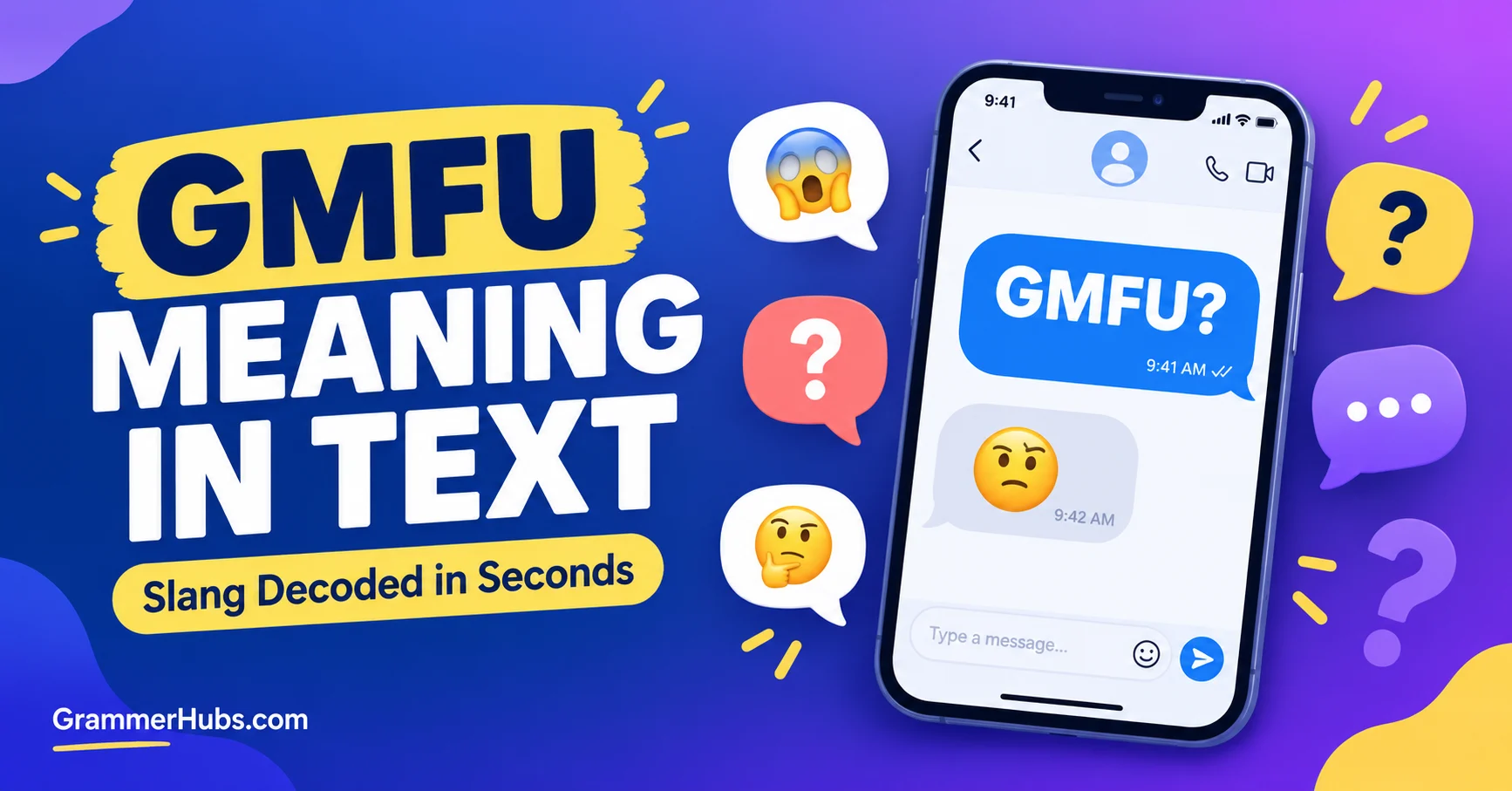
GMFU stands for got me f***ed up. In a text, it means something that shocked, confused, or annoyed the sender. Most of the time it is a loud, informal reaction. It can be a joke between friends, or it can be real anger. The tone around it tells you which.
Got a gmfu you can’t read? Check the emoji, the topic, and who sent it. Then jump to How to reply.
gmfu:Is that a compliment? An insult? A joke?
Honestly, it could be any of the three. That’s why this little acronym trips people up. Below, you’ll find what it means, where it came from, how to answer it, and when to keep it out of your own messages. Everything here comes from how the term is used in real chats and comment sections, not from guesswork.
What Does GMFU Mean in a Text?
GMFU is short for got me f***ed up. It belongs to the same family as you got me messed up and you got me twisted. All three say the same thing: that hit me hard, or you have the wrong idea about me.
The feeling behind it changes from message to message. Here are the four you’ll meet most.
Disbelief. Someone tells a story that sounds made up.
Maya: He says he bought a Lambo on a part-time salary.
Jay: gmfu 😭 no way
Frustration. Life is not going well.
Sam: They cancelled our flight. Again.
Lee: gmfu. Third time this year?
Playful pushback. A friend is bragging, and you are not buying it.
Zoe: I’m the best cook in this house.
Max: gmfu, you burned water yesterday 😂
Being impressed. Less common, but real.
Ana: Ran ten miles before work.
Kris: gmfu?? that’s not good
Notice what changes each time. It isn’t the word. It’s the emoji, the topic, and the friendship. A crying-laughing face and a joke point to humor. A short, flat reply after bad news points to real irritation.
Where Did GMFU Come From?
No one can point to the first person who typed it, and slang has no official record. But the path is easy to trace.
First, dictionary-style sites often disagree on small details. Second, a few low-quality pages push odd alternate meanings that show up almost nowhere in real use. If someone you know sends it in a chat, the meaning above is the one to assume.
How People Actually Use It
Where you see GMFU shapes how you read it.
In private texts, it reacts to news or gossip. It is usually casual, and the sender expects you to laugh or share the shock.
In the comments, it is quick, this is wild. Under a viral clip, gmfu 💀 just means I can’t believe what I’m watching.
In gaming chat and Discord, it fits the heat of the moment, like a bad round or an unfair loss.
Tom: Got sniped from across the map.
Ben: gmfu, that was so cheap
In an argument, it turns sharper. Without an emoji, it can mean I’m angry, and I want you to know.
One habit worth learning: the more personal the message, the more weight the word carries. gmfu after a stranger’s video is casual. gmfu, you always do this as an accusation.
Tone signals to watch:
- Emoji like 😭 😂 💀 usually mean humor
- No emoji, short text, or a period often means real frustration
- Capital letters raise the volume
- Timing matters. A fast reply to a joke reads light. A late, flat reply reads cold.
GMFU vs. Similar Slang
| Phrase | What it says | Strength | Safe at work? |
| GMFU | That hit me hard | Strong | No |
| You got me messed up | You’ve misjudged me | Medium | Sometimes |
| WTF | What is going on? | Strong | No |
| SMH | I’m disappointed | Mild | Usually |
| FML | My life is unlucky | Medium | Rarely |
| No way | I don’t believe it | Mild | Yes |
| Are you serious? | Please confirm | Mild | Yes |
The main difference: WTF asks a question. GMFU reacts to a feeling. SMH is quiet. GMFU is loud. And FML is about your own bad luck, while GMFU can be about anything.
If you want the same feeling with less risk, no way, you’re kidding, or are you serious? do the job almost anywhere.
How to Reply to GMFU
Match the mood first. Then choose your style.
Casual
Friend: gmfu, you actually won?
You: Yep 😄 still can’t believe it
Funny
Friend: gmfu, you ate the whole pizza?
You: In my defense, it looked lonely 🍕
Kind (when they are truly upset)
Friend: gmfu, they lost my order again.
You: Ugh, that’s annoying. Want help calling them?
Professional
Coworker: gmfu, the file vanished.
You: Understood. Let’s check the backup folder together.
Keeping your distance (when gossip is involved)
Contact: gmfu, did you see what she posted?
You: I’d rather stay out of it. Hope you’re okay though.
When you truly can’t tell
Sender: gmfu
You: Good gmfu or bad gmfu? 😅
Work, School, and Dating Apps:
At work or school
Skip it. It includes profanity, and screenshots last forever. Even in a relaxed office, it can make you look careless. Use plain words instead:
| Instead of | Try |
| gmfu, this is a mess | This isn’t what I expected. |
| gmfu, they changed it again | I’m surprised by this change. |
| gmfu, that’s unfair | Can you help me understand the reasoning? |
If a coworker sends it to you, you don’t have to copy them. Reply in your normal voice. If it feels aggressive, speak to them privately or follow your workplace process.
On dating apps
Here it can go either way.
Works:
Match: I haven’t seen a single 90s movie.
You: gmfu 😂 we’re fixing that this weekend
Doesn’t work:
Match: I’m not big on long chats.
You: gmfu
The second one feels cold, and the other person may pull back. On apps, add an emoji, skip it in the first few messages, and never use it after someone shares something personal. If a match sends it in a way that feels like an insult, you’re free to set a boundary, block, or report.
In group chats
Read the room. If the group bans profanity, leave it out. If everyone jokes this way, it will blend in.
Is It Offensive?
It depends on who is reading. The word hidden inside the letters is profane, so older relatives, teachers, and managers may take offense even if you meant it lightly.
Sarcastic use can also sting. Telling someone gmfu after they share good news can feel like mockery.
Some people also read it as a rough good morning greeting between very close friends. That use is rare and depends entirely on friendship. Don’t rely on it with anyone you don’t know well.
A simple rule: if the other person might be hurt, use plain words. That’s shocking and That sounds rough and can’t be misread.
Also, the term shifts by region and age group. It is most common in U.S. online spaces among teens and young adults. Elsewhere, people may not know it at all. If you’re chatting across cultures, clear words beat slang.
FAQs
What does GMFU mean in a text?
It means got me f***ed up. People use it to show shock, confusion, frustration, or playful disbelief.
Is GMFU rude?
It can be. It contains profanity. Among close friends it’s often casual. With bosses, teachers, or family, avoid it.
Can GMFU be a good thing?
Yes. Some people use it when they are impressed or stunned. Check the emoji and the topic.
How do I know if the sender is angry or joking?
Look at the emoji, the punctuation, and your history with them. If it’s still unclear, ask: Good or bad?
Is GMFU the same as WTF?
They’re close. WTF asks what’s happening. GMFU shows how strongly something landed.
Is it okay for work emails or school messages?
No. Use clear, polite wording like I’m surprised or That’s unexpected.
Where will I see it most?
In text chats, TikTok and Instagram comments, Discord, and gaming lobbies.
Conclusion
GMFU means got me f***ed up, a loud, informal reaction to something shocking, annoying, or impressive.
- Tone decides the meaning. Check the emoji, the topic, and the person.
- It contains profanity. Skip it at work, at school, and with people you don’t know well.
- Reply to the feeling, not the acronym. Joke back, comfort them, or just ask.
- When in doubt, use plain words. No way and Are you serious? work almost everywhere.
Slang changes quickly, and no glossary catches every shift. If a message confuses you, one short question beats a wrong guess.
Discover More
UT Mean In Text? What You There? Really Means
FYD mean? Sarcastic, sweet or business how to use it right or skip.
TYB What Really Means in Text: Thank You Bro or Take Your Bow?












1 thought on “GMFU in a Text? TWO Meaning, Replies & When to Avoid It 💬”