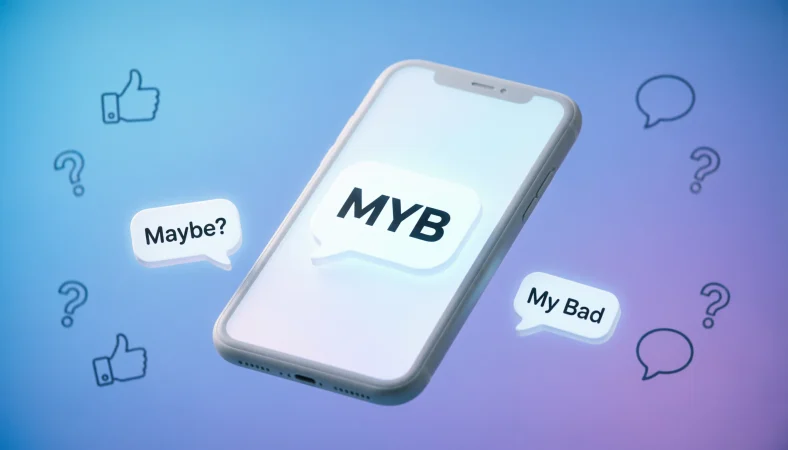
MYB usually means maybe. Less often, it means my bad. Which one you’re looking at depends entirely on what the message is responding to and that small ambiguity is the whole reason this abbreviation trips people up.
I’ve noticed this one causes more confusion than most texting shorthand, and it’s not because the abbreviation is obscure it’s because it does double duty. Text someone myb after they ask about weekend plans, and you’re being noncommittal. Text myb after ghosting a group chat for two days, and you’re apologizing. Same three letters, two completely different jobs. That’s worth untangling properly, because guessing wrong changes how you read the tone of an entire conversation.
What MYB Actually Means
MYB stands for maybe in the vast majority of cases. It works exactly like the full word does: it signals possibility without commitment.
Sam: Are you coming to the party tonight?
Jess: myb, depends on work
Jess isn’t saying no. She’s also not saying yes. She’s buying herself time, which is really what maybe is for in any conversation, typed or spoken.
The second meaning, my bad, shows up when MYB follows something that sounds like a slip-up rather than a question:
Alex: You left us on read for two days lol
Riley: myb, been slammed at work
Riley isn’t weighing in on a possibility she’s owning a small mistake. No dictionary entry can tell you which meaning applies; the sentence before it always will. If the message is answering will you / could you / are you, it’s maybe. If it’s responding to something that already happened, it’s almost certainly my bad.
This kind of context-dependent slang is common in texting; plenty of abbreviations shift meaning based on what surrounds them rather than carrying one fixed definition, which is part of what makes decoding a stranger’s messages harder than decoding a close friend’s.
Where MYB Came From
The short version: character limits made this normal, and habit kept it alive long after the limits disappeared.
Back when SMS messages were capped at 160 characters and typing on a numeric keypad meant multiple taps per letter, shaving letters off common words wasn’t optional, it was practical. None of it was clever; it was just faster.
What’s more interesting is that smartphones didn’t kill the habit. Full keyboards showed up, autocorrect got good, and people kept typing myb anyway because by then it wasn’t about saving keystrokes, it was just how casual texting sounded. Twitter’s early character limits reinforced the same instinct a decade later, and gaming chat did the same thing for a different reason: typing while playing rewards speed, not spelling.
So MYB isn’t really a new slang term. It’s an old habit that never had a reason to go away, picked up along the way by every new platform that rewarded quick typing over full sentences.
How MYB Shows Up In Real Conversations
The meaning barely changes across platforms the tone around it does.
Among friends, it’s usually stacked with other shorthand:
myb, lemme check my schedule
In a comment section answering a public question, it’s often upbeat:
myb! depends on the weather
In gaming chat, it’s fast and decision-focused:
Teammate: push mid? You: myb, wait for backup
On a dating app, it’s a low-stakes way to keep a plan loosely alive without overcommitting:
myb we grab coffee this weekend, still figuring out my schedule
In a casual work Slack not a client email, a relaxed internal channel it can slip in the same way:
myb we push the meeting to Thursday? checking my calendar
Across every one of those, MYB is doing the same quiet job: keeping the door open instead of closing it. That’s really the whole appeal of the word. It’s softer than no, faster than let me check and get back to you, and honest about not having an answer yet.
Where People Get It Wrong
The biggest mix-up isn’t confusing MYB with some other term, it’s assuming it only ever means one thing. Read myb as maybe when someone actually meant my bad, and you’ll respond to an apology like it’s an open invitation. Read it the other way, and you’ll accept an apology nobody was offering.
There’s also a much smaller, mostly niche usage floating around some corners of the internet where MYB stands in mind for your business typically in blunt or confrontational exchanges. It’s rare enough that you’re unlikely to run into it outside specific online spaces, but it exists, so don’t be shocked if context doesn’t fit either of the two main meanings.
As for if MYB is rude or inappropriate: on its own, no. It’s a neutral abbreviation. What changes the read is everything around it. myb, my bad 😅 lands as sincere. myb. with a flat period and nothing else can land as dismissive, even if that’s not what the sender intended. That’s true of most short texting slang; the words rarely carry the tone; punctuation and timing do.
Similar Abbreviations Worth Knowing
A few related terms get used in the same kinds of moments MYB shows up in, and the differences matter more than they look:
- MB is almost always my bad, and only that. No maybe meaning attached, which makes it less ambiguous than MYB.
- IDK I don’t know, used for genuine uncertainty about facts, not plans.
- TBD to be determined, more common in scheduling contexts than casual chat.
- NGL not gonna lie, used to preface a blunt or honest opinion.
If you’d rather avoid the ambiguity of MYB altogether, that’s the easiest fix: use MB specifically when apologizing, and spell out maybe or use idk when you mean uncertainty. It costs you two extra letters and saves the other person a guessing game.
How To Respond, Depending On The Vibe
A casual friend deserves a casual reply:
all good, lmk if you’re free!
If you want to push for a real answer without sounding annoyed:
myb isn’t an answer 😂 yes or no?
In a work context, match the register without being stiff:
No worries let me know once your schedule’s confirmed.
And if you’d rather not press for details at all:
No pressure, just keep me posted whenever you know.
Is MYB Okay To Use At Work?
Depends entirely on the room. In relaxed, chat-based teams, startups, creative departments, internal messaging among peers it usually passes without a second thought. In anything formal client emails, official documentation, messages to leadership it’s better to spell things out.
Professional stand-ins that carry the same intent:
- I’ll confirm and follow up.
- Possibly let me check and get back to you.
- Apologies for the delay; I’ll have an update shortly.
Quick Answers
Does MYB mean the same thing every time you see it?
No it splits between maybe and my bad depending on what it’s replying to.
Is MYB the same as MB?
Not quite. MB is apology-only. MYB can go either way.
Is this a Gen Z-only term?
Not really. Its usage goes back to early texting, well before Gen Z slang was a phrase anyone used.
Can it come across as rude?
Rarely from the word itself the tone and punctuation around it do most of the work.
Should I use it in a work email?
No. Save it for casual chat-based messaging, not formal writing.
What if myb doesn’t fit either meaning in a message I got?
Check for the rarer mind your business usage is uncommon, but it exists in blunter exchanges.
The Bottom Line
Most of the time it means maybe a soft, low-commitment way to leave a plan open. Occasionally, it means my bad, a quick way to own a small slip without writing a paragraph about it.
Everything else: the platform, the punctuation, the emoji tacked on the end just shapes the tone, not the core meaning. Once that distinction clicks, a stray myb text stops being confusing and starts being exactly what it was meant to be: efficient.
Discover More!
FNF Mean In Text? 🔥 2026 Guide
YG Mean in Text? Every Meaning, Explained Fast
NK Mean in Text? 🤔 Meanings You Should Know