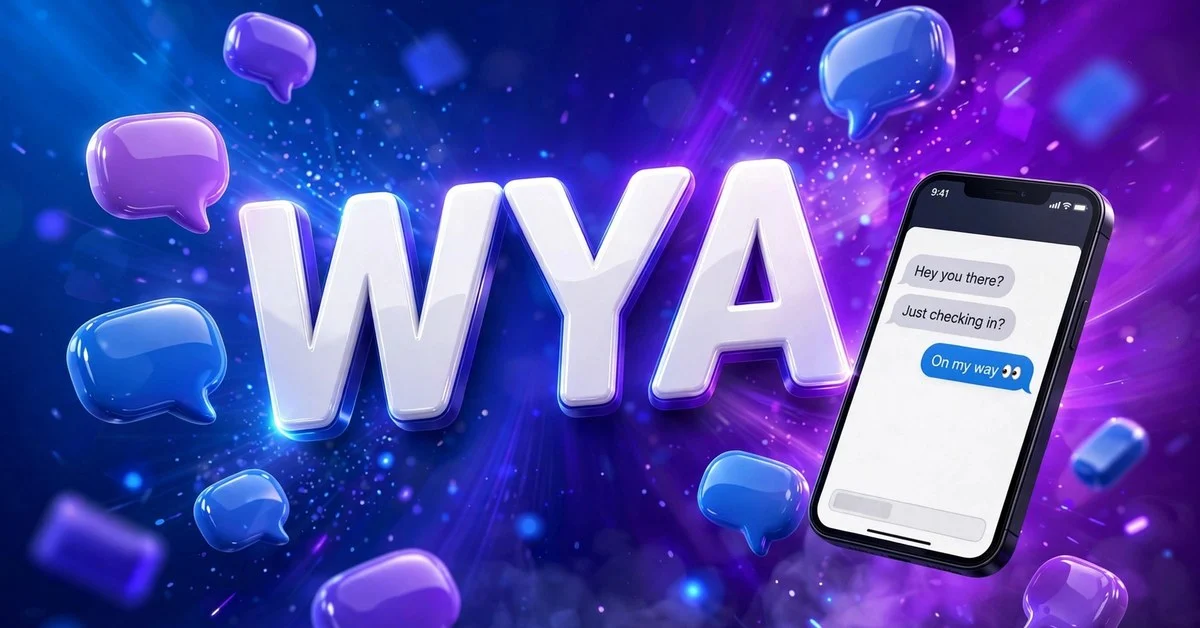
WYA means “where you at” in texting. It is a quick, casual way to ask someone where they are right now. If a friend texts you “wya”, they just want to know your location so you two can meet up or keep the chat going.
You have probably seen “wya” pop up in group chats, on Snapchat, or in DMs. It is one of those tiny slang words that does a lot of work. In this guide, I will break down exactly what WYA means, where it came from, how people use it in real life, and the best ways to reply when someone sends it your way.
What Does WYA Mean in Texting?
WYA stands for “where you at.” It is shorthand for asking “where are you?” People use it when they want a fast answer without typing out the full question.
The phrase drops the “re” from “where” and the “re” from “are,” which is typical of texting slang. Speed matters in chats, and WYA gets the point across in three letters.
Here is what it looks like in real conversations:
Example 1:
Jake: wya??
Mia: still at home, leaving in 5
Jake: cool, I am already at the mall
Example 2:
Sam: wya tonight
Alex: probably staying in, why?
Sam: party at Chris’s, you should come
As you can see, WYA is almost always a question about location. It can sound a little blunt on its own, so people often pair it with extra words like “wya rn” (right now) or “wya tonight” to make it friendlier.
One thing new texters notice fast: WYA rarely travels alone. It shows up with emojis, question marks, or follow-up texts that set the tone. “wya??” with two question marks feels urgent, like someone is waiting on you. “wyaaa” with stretched letters feels playful and relaxed. A simple “wya” with no punctuation is neutral. These tiny tweaks change how the message lands, so pay attention to them when you read one.
Example 3:
Mom: wya??
Tom: sorry, traffic is bad, 10 mins away
Mom: ok drive safe
Notice how the same three letters work for a worried parent, a friend making plans, and a teammate in a game. Context does the heavy lifting. The word itself is simple, but the situation around it tells you what the sender really wants.
Background and History of WYA
WYA did not start with smartphones. Its roots go back to hip-hop and urban slang in the late 1990s and early 2000s. “Where you at” was already common in spoken conversation, especially in American cities, long before texting took over.
When SMS texting became popular in the mid-2000s, every character counted. Old phone plans charged per message or capped you at 160 characters, so short forms like WYA were born out of pure necessity.
Then came social media. Platforms like Twitter, with its original 140-character limit, pushed abbreviations even further into daily life. Snapchat and Instagram DMs made WYA a staple of casual chat. By the 2010s, WYA was one of the most recognized texting abbreviations among teens and young adults.
Today, WYA shows up everywhere: texts, DMs, dating apps, and even memes. It has survived while other slang faded, mostly because it is just so useful. Three letters, one clear question.
Memes gave WYA a second life. You have probably seen the format: a photo of an empty chair with the caption “wya” or a screenshot of someone ignoring plans with “wya when the bill comes.” These jokes work because everyone knows the feeling behind the text. The meme version of WYA is less about location and more about calling someone out in a funny way.
TikTok and Reels pushed it further. Short videos with captions like “POV: your friend texts ‘wya’ but you are already home in bed” get millions of views. Each new platform finds a fresh angle on the same three letters, which is why WYA keeps feeling current instead of dated. Slang usually has a short shelf life, but WYA earned its staying power by being genuinely handy.
How WYA Is Used in Different Contexts
WYA is flexible. The meaning stays the same, but the vibe changes with the setting. Here is how it plays out across different parts of daily life.
Texting friends: This is WYA’s home turf. It is fast, casual, and normal between people who know each other well.
Leo: wya
Nina: gym, done in 20
Leo: bet, I will pick you up after
Social media DMs: On Instagram or Snapchat, WYA often kicks off plans. Someone might send it with a photo of a cool spot, hinting you should join.
Gaming: In game lobbies or Discord chats, players type “wya” to find teammates on a map. Speed matters here, so the short form wins.
Chris: wya on the map
Pat: near the tower, need backup
Chris: on my way
Casual check-ins: Sometimes WYA is less about meeting up and more about starting a conversation. A simple “wya” from an old friend might just mean “hey, what is new with you?”
Family group chats: Parents love WYA because it is short and gets answers. It is the modern version of calling the house phone to check if the kids are home.
Dad: wya
Emma: library, studying
Dad: ok, dinner at 7
Work group chats (informal ones): In relaxed workplaces, coworkers might drop a “wya” in Slack or WhatsApp when someone is late to a casual lunch. Keep it out of formal channels though. More on that later.

Common Misconceptions About WYA
A few mix-ups come up with WYA, so let us clear them up.
Misconception 1: WYA is rude. Not really. It can read as blunt in plain text, but between friends it is totally normal. Tone depends on who sends it and your relationship with them.
Misconception 2: WYA means “what are you doing.” Close, but not quite. WYA asks about location, not activity. If you want to know what someone is doing, you would say “wyd” (what you doing) instead.
Misconception 3: Only teens use WYA. Teens made it popular, but plenty of adults in their 20s and 30s use it too, especially in casual chats.
Misconception 4: WYA has a hidden dirty meaning. It does not. WYA is clean slang. If someone uses it weirdly, that is about the person, not the word.
Misconception 5: You must answer WYA right away. You do not. No text message creates a real obligation. If you are busy, driving, or just do not feel like sharing, reply when you are ready or not at all. A delayed answer is always better than an unsafe one, especially if you are behind the wheel.
Misconception 6: WYA is only for making plans. Plans are the main use, but people also send WYA as a joke, a meme caption, or a way to restart a dead conversation. Like most slang, it picked up extra jobs over time.
Similar Terms and Alternatives to WYA
WYA is not the only way to ask where someone is. Here are some close cousins you will run into:
- Wyd (what you doing): asks about activity, not location. Often paired with WYA: “wyd wya?”
- Hmu (hit me up): “contact me,” often used when making plans.
- Wuu2 (what you up to): another casual check-in.
- Where u at: the slightly longer typed-out version of WYA.
- Lmk (let me know): used when plans are forming: “lmk wya later.”
- HY: another short abbreviation that pops up in the same casual chats. Here is what HY means in text.
- HYC: a rarer abbreviation you might spot in DMs. Learn what HYC means in text.
| Term | Stands For | What It Asks |
|---|---|---|
| WYA | Where you at | Your location |
| WYD | What you doing | Your activity |
| HMU | Hit me up | To contact them |
| WUU2 | What you up to | Activity or plans |
How to Respond When Someone Texts WYA
Got a “wya” text and not sure what to say? Pick the style that fits the moment.
Casual replies (for friends):
“at home, wuu2”
“just left work, be there in 10”
“still in bed lol”
Funny replies (to keep it light):
“in your walls”
“mentally? on vacation”
“where I always am: avoiding people”
Polite replies (for people you do not know well):
“Hey! I am downtown right now, what is up?”
“Just running errands, did you need something?”
Privacy-conscious replies (if you do not want to share your location):
“around, why do you ask?”
“not too far, what is going on?”
You never owe anyone your exact location. A vague answer is perfectly fine, especially with people you just met.
Busy replies (when you cannot talk now):
“in the middle of something, text you later”
“driving, will reply when I park”
Short and honest beats a long silence. People respect a quick heads-up way more than being left on read.
Regional and Cultural Differences
WYA is understood across most English-speaking countries: the US, UK, Canada, and Australia all use it. It started in American urban slang but spread fast through music, social media, and texting culture.
In the UK, you might also hear “where you at” spoken with a local twist, and in grime and drill music the phrase pops up a lot. In Australia, teens use WYA the same way Americans do, often mixed with local slang.
Outside English, every language has its own shortcut. Spanish speakers might text “dnd estas” (donde estas), and French speakers use “t ou” (t’es ou). The idea is universal: quick location check-ins exist in every texting culture.
One fun detail: in some Caribbean and Southern US communities, “where you at” is said as “weyuhat” in fast speech, which is basically WYA spoken out loud. Texting slang often just writes down how people already talk. That is why WYA felt natural from day one. Nobody had to learn it. They just had to shorten what they were already saying.
WYA vs Similar Terms: Key Differences
People mix up WYA with a few lookalikes. Here is how they differ:
| Term | Meaning | Key Difference from WYA |
|---|---|---|
| WYA | Where you at | Asks for location |
| WYD | What you doing | Asks for activity |
| WYA vs WBU | What about you | WBU bounces a question back |
| WYA vs ETA | Estimated time of arrival | ETA asks when, not where |
The simplest rule: WYA = where, WYD = what. Once you lock that in, you will never mix them up.
WYA on Dating Apps and Online Communities
On Tinder, Bumble, and Hinge, WYA usually shows up once a match is going well and someone wants to meet in person. It is a green flag that they want to take things offline.
Example:
Alex: this convo is fun, wya this weekend?
Jordan: I am free Saturday, coffee?
A word of caution: on dating apps, do not share your exact location right away. Suggest a public place first and keep details vague until you trust the person.
In gaming communities on Discord or Twitch chat, WYA is pure logistics. “Wya” means “where are you on the map” and nothing more. Reply with your position and keep playing.
On Twitter/X, WYA sometimes appears in memes or call-out posts, like “wya when I needed you,” which is more of a joke format than a real question.
Reddit and forums use WYA in a slightly different way. On location-based subreddits, a comment that just says “wya” under a photo of a cool spot means “where is this place?” It is the same question, pointed at a place instead of a person. Context makes the meaning obvious.
Does WYA Have Any Hidden or Offensive Meaning?
No, WYA has no widely known offensive meaning. It is clean, everyday slang.
That said, tone and context always matter. A “wya” text at 2 AM from someone you barely know can feel pushy or suspicious. The same text from your best friend at noon is totally innocent. If a message ever makes you uncomfortable, trust your gut and do not feel pressured to answer.
Parents sometimes worry when they see abbreviations they do not know. If that is you: WYA is harmless. It just means “where are you.”
There is one more angle worth knowing. Scammers sometimes open with casual slang like WYA to sound like a friend before pivoting to a fake story. If a “wya” text comes from an unknown number and quickly turns into a request for money or personal info, that is a red flag. The slang is innocent. The stranger using it might not be. When in doubt, do not engage and block the number.
Is WYA Okay for Professional Communication?
Short answer: no. WYA is casual slang, and it does not belong in work emails, job applications, or messages to your boss.
Using WYA at work can make you look unprofessional, even if your workplace is relaxed. Stick to full sentences when the setting is formal.
Professional alternatives:
- “Where are you currently located?”
- “Could you share your location?”
- “What is your current whereabouts?”
- “Are you at the office?”
Save WYA for friends, family, and casual chats. Knowing when not to use slang is just as important as knowing what it means.
This matters more than people think. Managers form opinions from small signals, and slang in a formal message is one of them. You might be the most skilled person on the team, but a “wya” in a client email can undo that impression in seconds. Match your words to the room and you will never have to worry about it.
FAQs About WYA
What does WYA mean in a text message?
WYA means “where you at.” It is a casual way to ask someone where they are.
What does WYA mean on Snapchat?
The same thing: “where you at.” On Snapchat it often comes with a photo or video hinting at plans.
Is WYA flirty?
It can be, depending on context. A late-night “wya” from a crush might carry a flirty vibe, but most of the time it is just a normal question.
What is the difference between WYA and WYD?
WYA asks where you are (location). WYD asks what you are doing (activity).
How do you reply to WYA?
Just say where you are, or give a vague answer like “around, why?” if you prefer privacy.
Is WYA rude to say?
Not usually. It can seem blunt in text, but between friends it is completely normal.
What does “wya rn” mean?
“Where you at right now.” The “rn” just adds urgency.
Can WYA be used in a group chat?
Yes, and it often is. In a group chat, “wya” usually means “where is everyone” or it tags one person with an @ mention. Just make it clear who you are asking so five people do not answer at once.
Conclusion
WYA is one of the simplest pieces of texting slang out there: it means “where you at,” and people use it to check someone’s location fast. It grew from urban slang into a global texting staple, and it works in chats, DMs, games, and dating apps alike.
Now you know what it means, how to use it, how to reply, and when to leave it out of the conversation.
Next time a “wya” lands in your inbox, you will know exactly what to do. Want to decode one more piece of chat slang? Here is what’s HY mean in text.

I’m Chloe Mitchell, a passionate writer at Grammerhubs.com specializing in English grammar, word meanings, slang terms, and modern language trends. I create clear, engaging, and easy-to-understand content that helps readers master everyday English with confidence.










