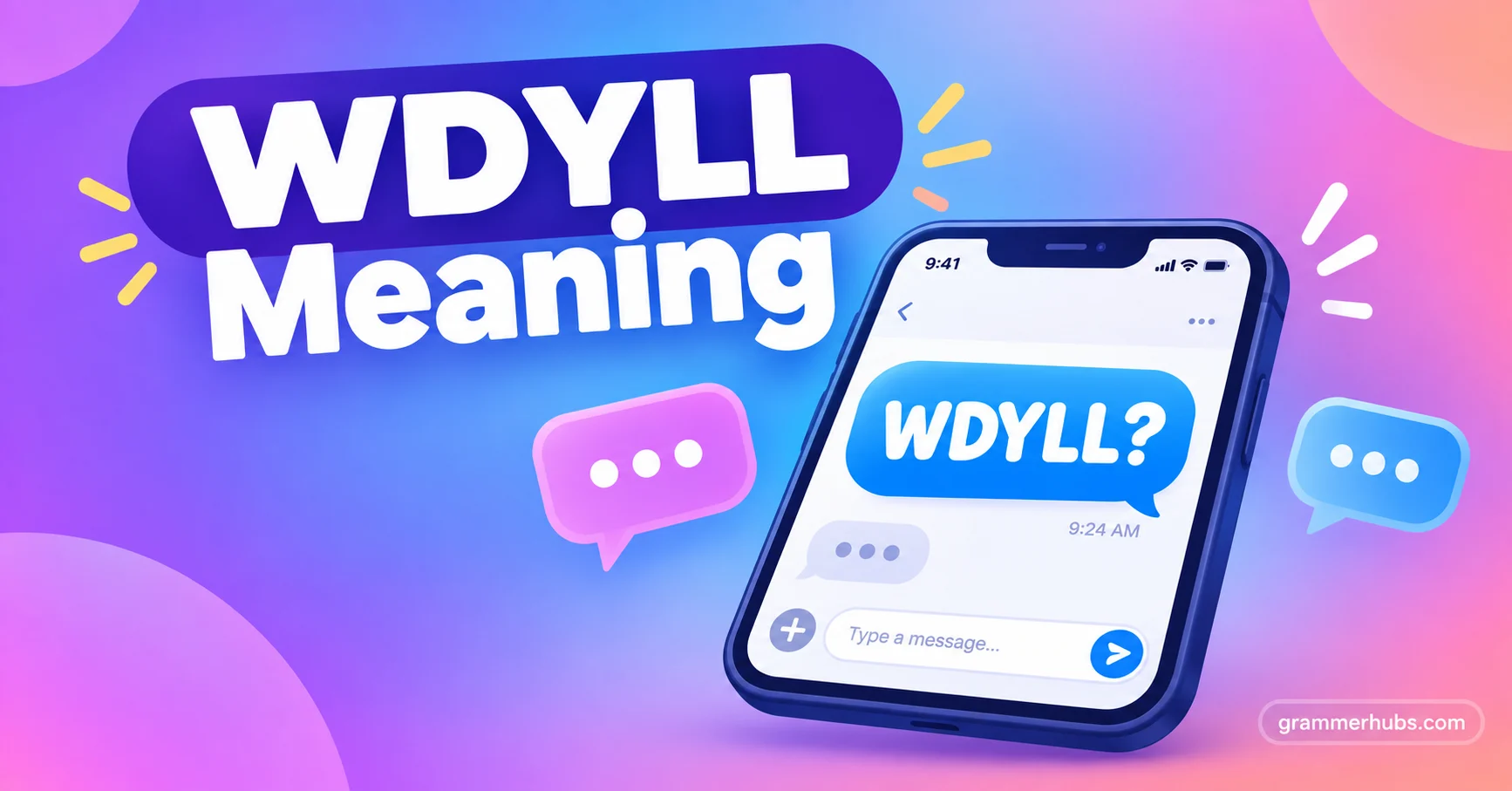
WDYLL means What Do You Look Like? Someone sends it when they want to know your appearance, usually a description or a photo after chatting with you online for a bit.
Here’s the scene. You’re a few messages deep with someone on Snapchat or in a group chat that started over a shared interest. The conversation is going fine. Then this lands: wdyll? No question mark, no context, no warning. You reread it twice. You still don’t know what it means.
You’re not slow for missing it. Texting slang moves fast, and it rarely comes with a manual. This one has been floating around chatrooms and DMs for years, quietly picking up new homes on every app that comes along Snapchat, TikTok, Discord, dating apps, gaming lobbies.
Below is everything worth knowing about it: where it came from, how people actually use it today, when it’s fine, when it isn’t, and a few solid ways to reply if you’d rather not just send a selfie and move on.
What WDYLL Means
WDYLL is short for What Do You Look Like? That’s no deeper trick to it. People type it as wdyll, WDYLL? or occasionally with a period instead of a question mark, since punctuation tends to be the first casualty of fast texting.
It’s a request for a description or, more commonly, a photo. You’ll usually see it after two people have been talking for a while without ever seeing each other’s faces:
Jordan: We’ve been talking for a few days now. Alex: Yeah, it’s been nice actually. Jordan: wdyll?
Or somewhere in the middle of a gaming session:
Liam: We’re actually a solid team. Ava: Same taste in games too. Liam: wdyll though?
A lot of people search this wondering if the meaning shifts depending on who’s sending it whether it’s wdyll from a girl, wdyll from a guy, or a stranger in a group chat. It doesn’t. The words mean the same thing no matter who types them. What changes is the intent behind it, and that comes down to tone and how well you already know the person, not the letters themselves.
Where WDYLL Came From
This kind of shorthand didn’t start on TikTok. It goes back to AIM and early flip-phone texting, when every character you typed cost you something either time on a tiny keypad or literal money per text message. What do you look like in nine words? WDYLL is one. That trade-off is the whole reason abbreviations like this exist in the first place.
Back then, chatrooms were full of strangers with no profile photos and no video calls, so basic identity questions became their own shorthand family: ASL (age, sex, location), ASF (age, sex, from), and eventually WDYLL. They were the polite, quick way of asking who I am actually talking to.
The interesting part is how little the core question has changed. What’s different now is just the packaging. It moved from AIM windows to Snapchat streaks and TikTok comment sections, but the underlying ask is identical to what it was twenty years ago.
How People Use It Today
Context does most of the work here. The same five letters land differently depending on where they show up.
In regular texting, it’s usually low-stakes sent between people who already have some rapport built up.
On Snapchat, it fits naturally because the app is built around photos anyway. Someone asking wdyll on Snap is usually expecting a quick snap back, not a written paragraph.
On TikTok, it shows up in comments or DMs after someone reacts to a video a lighter, more public version of the same curiosity. It’s less who you are and more what do you actually look like behind this content.
In gaming chats, it tends to surface after a good match or a few rounds of solid teamwork, when people want to put a face to whoever they’ve been playing with. A few Discord servers have even turned it into a running bit, half-jokingly calling the person who always asks it the group’s wdyll warrior.
On dating apps, it’s the most direct version, often one of the first messages after a match, working as a softer way to ask for a clearer photo than the profile provides.
What It Doesn’t Mean (And Where People Get Confused)
The most common mix-up is assuming WDYLL only has one reading. There’s a lesser-used second meaning floating around What Do You Like/Love? which asks about interests, not appearance. You can usually tell which one you’re dealing with from what came before it. If the chat’s been about hobbies or favorite games, it’s probably the like/love version. If it followed small talk about meeting up or general curiosity about the person, it’s almost certainly asking about looks.
A second mix-up: people sometimes type or search hdyll after misreading or mistyping WDYLL. It’s not really its own term, it’s just a typo that happens often enough to show up in search data.
And a third: assuming it’s automatically flirty. It isn’t. Plenty of WDYLL messages come from gaming teammates or new online friends with zero romantic angle at all.
WDYLL vs. Similar Texting Acronyms
It helps to see this next to the terms it gets confused with:
| Term | What It Asks | Where You’ll See It |
| WDYLL | What do you look like? | Snapchat, texting, dating apps |
| WYLL | What you look like (shorter version of WDYLL) | Texting, DMs |
| WYD | What are you doing right now? | Texting, casual check-ins |
| ASL | Age, sex, location | Older chatroom slang, still used occasionally |
| WDUD | What do you do? (job/daily life) | Texting, dating apps |
The one worth remembering: WDYLL is about appearance, WYD is about activity. They look similar, typed out fast, but they’re not asking for the same thing at all, easy to mix up mid-conversation if you’re skimming.
How to Reply to WDYLL
There’s no single correct answer here; it really depends on how comfortable you feel. A few directions that all work:
If you’re happy to answer casually:
Brown hair, still in yesterday’s hoodie, no shame. wdyll?
If you’d rather keep it light and dodge a direct answer:
Picture a slightly tired superhero who’s bad at cooking.
If you’re not ready to share anything yet:
I’d rather hold off on that for now, but happy to keep chatting.
None of these are wrong. A photo isn’t owed just because someone asked a short reply, a joke, or a polite pass are all completely normal responses in this kind of chat.
Does Culture or Region Change the Meaning?
Not really. WDYLL is an English-language, internet-native term, most common among teens and young adults in the US, UK, Canada, and Australia. It hasn’t picked up widespread translations elsewhere, mostly because slang like this tends to travel with the app it’s used on rather than with a specific language.
What shifts by region is how forward it feels. In some online spaces, it’s a completely normal icebreaker. In others, asking about someone’s appearance early in a conversation reads as unusually direct. There’s no fixed rule, just the general pattern that existing rapport and platform norms shape how the question lands.
On Dating Apps and Online Communities
On apps like Tinder, Bumble, or Hinge, WDYLL tends to show up early, often right after a match and before much real conversation has happened. It’s a low-effort way of asking for a clearer photo than whatever’s on the profile.
On platforms like X (formerly Twitter), it shows up less in private messages and more in public reply threads, usually as a throwaway question rather than a serious one.
In gaming spaces, it tends to follow a good session of people wanting to connect a face to whoever they just played three rounds with. That’s also where the joking wdyll warrior label tends to stick to whoever asks it every single time.
One thing holds across every platform: you’re never required to answer right away. Maybe later is a completely normal, widely understood response.
Is There a Hidden or Offensive Meaning?
Not really. WDYLL is plain curiosity wearing an abbreviation. That said, tone and timing matter more than the letters themselves. Asked repeatedly, too early, or with pressure attached, it can start to feel intrusive but that’s about how it’s being used, not what it means. If a conversation starts feeling pushy, trust that read over the dictionary definition.
Is WDYLL Okay to Use at Work?
No keep it out of professional messages entirely. It’s casual slang through and through, and using it with a coworker or in a formal email lands as out of place at best. If you actually need to confirm what someone looks like for a work meeting, plain language does the job better: Could you tell me what you’ll be wearing so I can spot you?
Frequently Asked Questions
What does WDYLL mean in text?
What Do You Look Like? Casually ask for someone’s appearance or a photo.
Does WDYLL mean something different from a girl or a guy?
No. The meaning stays the same regardless of who sends it. Only the context around it changes.
What does WDYLL mean on Snapchat and TikTok?
Same core meaning on both it just tends to lead to a quick photo exchange on Snapchat, and shows up more in comments or DMs on TikTok.
Is WDYLL rude to send?
Not inherently. It’s common and casual, but asking too soon or too often can come across as forward.
How should I reply if I get a WDYLL text?
However you’re comfortable with a description, a joke, a photo, or simply saying you’d rather not share yet. All of those are fine.
Is WDYLL the same as WYD?
No. WYD asks what you’re doing right now. WDYLL asks what you look like. Different question entirely.
Final Takeaway
WDYLL is a small, practical piece of texting shorthand with one job: asking what someone looks like. It’s been around in one form or another since the earliest chatroom days, and it’s simply followed people onto whatever app they’re using now Snapchat, TikTok, Discord, dating apps, gaming chats. The meaning hasn’t really changed; only the scenery has.
If you get one, there’s no pressure to respond a certain way. Read the context, answer however feels comfortable, and remember that sharing anything, a photo, a description, or nothing at all is entirely your call.
Discover More About!
SDIYBT Mean in Text: Viral Slang Explained Fast
MK Mean in Text: The Real Meaning Explained
WFY Meaning ⚡ Decode This Texting Abbreviation in Seconds
I’m Sarah Jenkins, a professional content writer at GrammerHubs.com, specializing in clear, engaging articles on grammar and modern slang meanings. I break down complex language rules and trending text terms like actions and replies into simple, in-depth guides that help readers communicate with confidence and clarity.