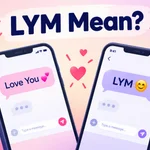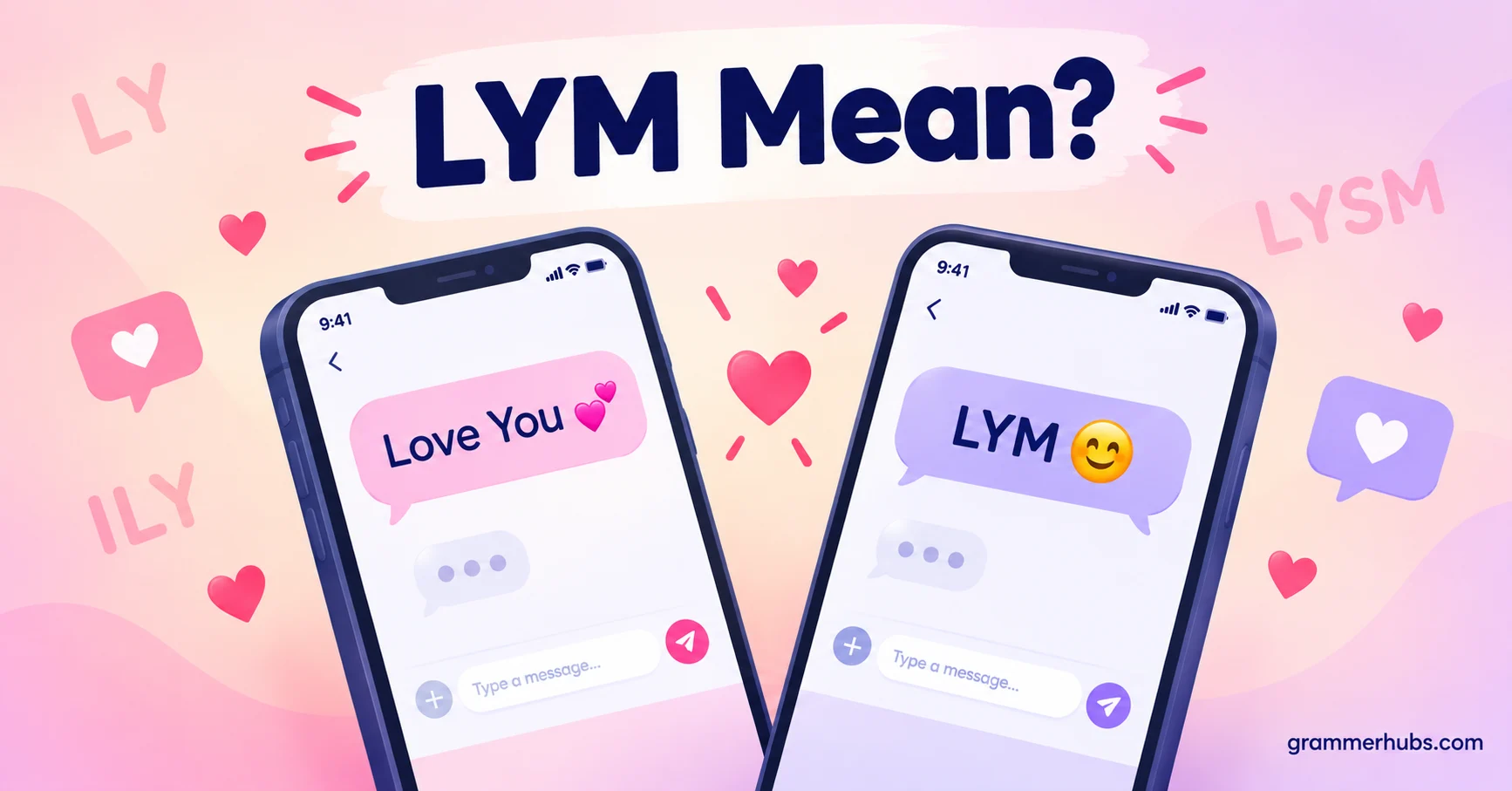
LYM stands for Love You More. It’s the go-to comeback when someone texts you and you want the last word, a quick way of saying yeah, well, I love you even more than that.
You’ll mostly see it between partners, close friends, and family, on iMessage, Instagram, Snapchat, and TikTok.
If you just got a text that said lym and had a small moment of panic, you’re not alone. A new slang word, or some inside joke you’re missing. It’s none of those. It’s one of a small handful of love-themed texting abbreviations LY, ILY, LYSM that people lean on when a full sentence feels like too much effort for how they’re actually feeling.
What LYM Actually Means
LYM is short for Love You More. It belongs to a small family of affectionate acronyms: LY (love you), ILY (I love you), and LYSM (love you so much). What sets it apart is that it’s almost always a response. One person says love you, the other fires back lym a tiny, ongoing tug-of-war over who loves who more.
You’ll see it play out like this:
Partner A: Heading to bed, love you 💕
Partner B: lym 😴
Or between friends, where it’s a little looser and often tacked onto a compliment:
Friend A: You’re seriously the best, thanks for today.
Friend B: aww lym fr
It works because it’s short, warm, and instantly readable to anyone who texts regularly. No paragraph requiring three letters does the job.
One thing worth flagging early:
This is personal, casual language. You won’t see it in a work email or a client message, and if it shows up from a coworker, it’s almost certainly a text meant for someone else.
Where LYM Came From
Nobody coined LYM on purpose; it grew out of the same pressure that shaped most texting slang: small keyboards, character limits, and people typing with their thumbs. I love you got shortened to ILY. Love you became LY. And the natural reply to that, love you more, eventually got squeezed down to LYM.
It grew up alongside a wider group of affectionate shorthand LMY (love and miss you), LYSM (love you so much), XOXO all born from the same instinct: say the feeling, skip the typing. When social platforms took over from plain SMS, that habit only got stronger. Instagram captions, Snapchat replies, and X comments all reward short, punchy phrasing, and LYM fit right in.
These days, you’ll run into it mostly in these places:
- Instagram comments and DMs, often on a couple’s or family photo
- Snapchat a quick, affectionate reply inside a streak or chat
- iMessage and WhatsApp between partners, close friends, and family
- TikTok comment sections under relationship or family content.
How LYM Shows Up in Different Situations
The letters don’t change, but the tone shifts depending on who’s texting.
Between partners
This is the classic setup one person says love you, the other tops it:
Him: Can’t wait to see you tomorrow, love you
Her: lym, counting down the hours 🥰
Between friends
Looser, often with a joke or a fr (for real) attached:
Friend 1: You seriously saved my whole day.
Friend 2: lym bestie, always here for you.
In family chats
A quick way for a parent, sibling, or kid to close out a text without writing a full sentence:
Mom: Drive safe, love you sweetheart.
You: lym mom 💛
In comments and captions
It shows up a lot under couple photos, throwback posts, or anniversary captions as a way to show affection publicly without writing a whole paragraph in someone’s comment section.
In gaming and Discord chats
Less common here, but it does turn up between close friend groups who’ve carried their texting habits into voice chat and group messaging usually as a sign-off after a long session together.
Across all of these, it’s doing the same basic job: keeping the exchange warm and light instead of heavy or formal.
Where People Get It Confused
The most common mix-up is mistaking LYM for one of its lookalikes:
- LY just means love you no comparison, no comeback.
- LMY usually means love and miss you. It’s about distance and longing, not who loves who more.
- LYSM means love you so much as an intensifier, not a reply.
A second misconception: people assume LYM is always romantic. It isn’t. It shows up just as often between siblings, friends, and parents the warmth stays the same, the romance is optional.
And no, it isn’t secretly sarcastic. Unlike a lot of slang that’s picked up an ironic second life, LYM has mostly kept its original, sincere meaning. When it does get used as a joke, usually stretched out as lymmmm or dropped into a clearly teasing exchange.The sarcasm comes from the surrounding conversation, not from the letters themselves.
LYM vs. Its Closest Relatives
If LYM doesn’t quite fit the moment too romantic, too casual, or just not the right vibe here’s how it stacks up against the terms people usually reach for instead:
| Term | Meaning | Tone | Best used between |
| LYM | Love you more | Warm, comparative | Partners, close friends, family |
| LY | Love you | Light, everyday | Anyone you’re close to |
| ILY | I love you | Direct, sincere | Partners, family |
| LYSM | Love you so much | Intense, emphatic | Partners, best friends |
| LMY | Love and miss you | Longing | Long-distance friends or partners |
| LYLAS | Love you like a sister | Platonic, close | Close female friendships |
| XOXO | Hugs and kisses | Casual, generic | Anyone, low commitment |
The thing that sets LYM apart from the rest of this list is that it’s almost always a reaction. LY and ILY can open a conversation on their own. LYM, by design, is built to follow someone else’s love for you.It only really works as the second half of the exchange.
How to Reply to LYM
What you send back depends entirely on your relationship and the mood of the conversation.
If you want to keep it light:
lol no lym
If you’re playing along with the who loves who more bit:
impossible, i love you the mostest
If you mean it, and want it to land that way:
there’s no more to give, you already have all of it
If it clearly wasn’t meant for you (a coworker or acquaintance texted the wrong thread):
Haha, I think this one was meant for someone else. I hope you’re having a good day!
And if you genuinely can’t tell what someone meant, it’s fine to just ask. Aw, lym? or a simple what’s that mean? keeps things easy without turning a three-letter text into a whole conversation about itself.
Does LYM Change by Region or Language?
LYM is mostly an English-language habit, and its use skews heavily toward the U.S., U.K., Canada, and Australia anywhere English-language texting culture dominates. In non-English-speaking countries, people tend to type out the equivalent phrase in full rather than abbreviate it, since the shorthand doesn’t translate letter-for-letter into other languages.
LYM on Dating Apps and Social Platforms
On apps like Tinder, Bumble, or Hinge, LYM isn’t usually an opening-message kind of term; it shows up later, once two people are already comfortable or officially together. If a match drops it early, it can feel like a mismatch in pace, so it’s worth reading the room before mirroring that level of affection back.
On X (formerly Twitter), it tends to show up in replies under emotional or wholesome posts, relationship milestones, throwback photos, that kind of thing. On Discord and other gaming platforms, it’s rarer, but still pops up between close friend groups as an affectionate sign-off.
The general rule for responding well:
match the energy you were given. Sincere gets sincere.
Is There a Hidden or Offensive Meaning?
No LYM doesn’t have a widely recognized negative or offensive alternate meaning. Some acronyms pick up a second, less innocent life online. This one hasn’t really. It’s stayed close to its original, sincere use.
Should You Use LYM in Professional Messages?
No. Keep it out of work emails, client messages, and anything formal. LYM belongs to personal relationships, partners, friends, family and using it in a professional context risks landing wrong or reading as unintentionally familiar.
If you’re trying to sound warm in a professional setting thanking a colleague, wrapping up a good working relationship, stick to something like thank you so much or really appreciate you. Save LYM for the people who’ll actually get the joke.
Frequently Asked Questions
What does LYM mean in a text from a girl or guy?
It means love you more a quick, affectionate reply to someone else’s love you text. It’s not tied to one gender; anyone uses it.
Is LYM only for couples?
No. It’s common in romantic texting, but friends and family members use it just as often, just without the romantic undertone.
What’s the difference between LYM and LY?
LY simply means love you. LYM specifically means love you more and is usually sent as a direct reply to LY.
Can LYM be sarcastic?
It can be, but that’s the exception, not the rule. Its default meaning is sincere sarcasm usually comes through in tone, punctuation, or context, not the acronym itself.
Can you send LYM first, without someone saying love you first?
Yes. It’s most natural as a reply, but sending it first isn’t wrong. Some people find it cute to win the exchange before it even starts.
Does LYM mean the same thing everywhere Instagram, Snapchat, iMessage?
Yes. The meaning holds steady across platforms. What changes is the setting, not the definition.
Is it ever okay to use LYM in a professional message?
Generally, no. It’s casual, personal slang. Stick to full phrases like thank you or appreciate you in work contexts.
The Bottom Line
LYM means love you more, nothing more mysterious than that. It’s a small, low-effort way of keeping an affectionate exchange going, usually as the second half of a love you / love you more back-and-forth between partners, friends, or family.
The part worth remembering is context. The same three letters can be a genuine reply, a running joke between best friends, or if it lands in the wrong chat, a slightly awkward moment for a co-worker. Know who you’re talking to, read the tone around it, and you’ll never have to second-guess another LYM again.
Discover More Posts!
DB Meaning in Text: Database, Dumbass, or Don’t Bother?
GB in Text: Goodbye, Gigabyte, or Something Else?
IMU Mean in Text? Here’s the Real Answer